Capital Cultures
Ottawa · Canada Get the lettersThe letters FR

Vendors · 01 of 03 · terms & rates

What a pitch buys, and what it costs.

A flat fee, paid up front, for a marked piece of ground with your name on the site plan. The number is being set inside the corridor on this page, and it publishes with the terms in winter 2027.

Our plan for 7–8 August 2027 at LeBreton Flats, subject to permits · rates are being set

Three ways to stand on this field.

A trader takes a pitch and pays for it. A community runs a pavilion under an entirely separate agreement. The festival itself keeps two lines out of both hands.

Status · 29 August 2026 · terms publish winter 2027

Vendor pitches · community pavilions run under separate terms
01

A food pitch

You cook in an approved commercial kitchen and the field is where you hold, assemble and serve. A certified food handler stands on the point in every operating hour, and the public-health application for that point is yours to file.
02

Packaged food

Sealed, shelf-stable goods — spice blends, preserves, coffee beans, honey, sweets. Lighter kit, a lighter kitchen requirement, and a shorter conversation with Ottawa Public Health about storage and handling.
03

The craft row

Embroidery, pysanka, weaving, ceramics, jewellery, instruments. The jury asks one question of every application: did you make this? Resale is refused at that stage, because a row that fills with resale stops being a craft row inside a month.
04

A community pavilion

A different arrangement entirely, and it says so out loud: the pitch fee is $0 and every dollar over the counter stays with the community. A community organisation applies for that through the pavilion door.
05

Two lines the festival keeps

Bottled water runs as a single festival line at one price across the whole field. The first edition serves no alcohol at all, which closes the liquor permit, the second sanitation tier and the police sergeant that comes with them.
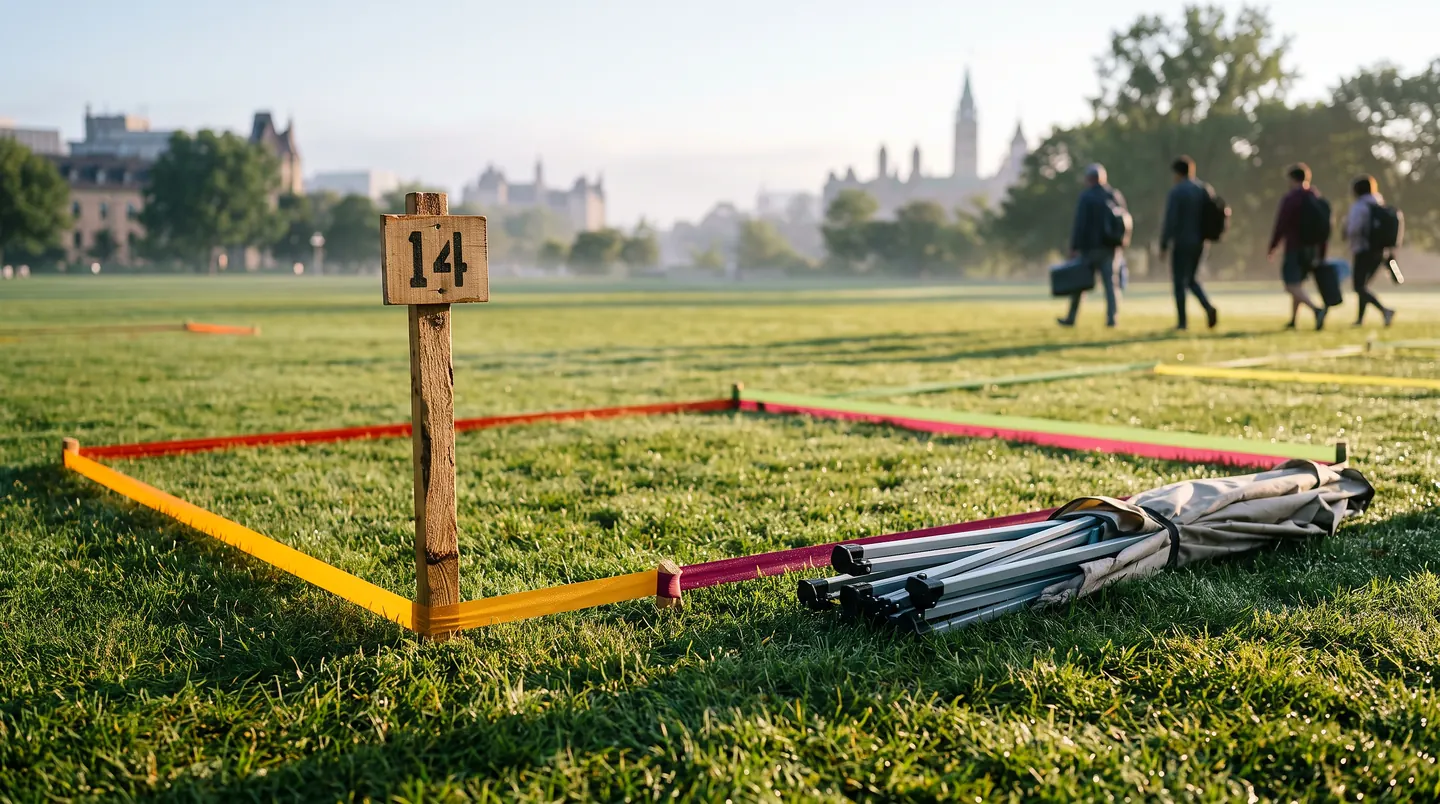
A numbered wooden stake marking a pitch on the grass, its corners taped out in yellow, red and pink, a folded tent and its poles bundled beside it, people walking away across the field towards the Parliament skyline in morning haze.
A pitch, taped out and numbered, the morning before load-in

Inside the fee, and outside it.

Ottawa's published rates split the same way ours will. Everything in the left column arrives with the pitch; everything in the right arrives with you, on your own paperwork and at your own cost.

The split every Ottawa festival makes · ours is written the same way

01 · inside the fee

The ground and your place on the plan

A marked pitch with a stated frontage, your position on the published site map, your line on the approved price list, load-in and load-out windows, waste and recycling points, wayfinding that names you, and the crowd two days of programming brings onto the field.

02 · outside the fee

Everything that stands on the pitch

Your tent, counters, weights, fridges, fryers, propane, staff and stock. Power, metered and sold by the outlet. Your $2,000,000 certificate of insurance. Your public-health permit if anything on your table is edible. Water beyond the shared refill points.

  • The fee is flat and paid up front. Capital Pride Ottawa published $400 a day and $700 for the weekend in 2026, with power and water outside the rate and the vendor's own health permit outside it too. Our terms are written on the same shape.
  • A flat prepaid rate leaves the weather with you. A rained-out Saturday stays your risk under a flat fee, and this page says so a year before anybody signs a thing.
  • Power is metered. The draw you declare on your application is what gets cabled to your frontage, and Fiestaval's published $50 for a 10 A outlet is the benchmark ours sits against. Generators stay off the field for noise and for fire clearances.
  • A craft pitch is smaller and cheaper than a food pitch. Stewart Park in Perth juries a ten-by-ten at $235 plus HST for three days, about $78 a day, and that line is the benchmark for our row.
One flat fee, published in full before a single application opens, with every line it covers written next to it.
The trade terms of Capital Cultures, stated 29 August 2026 · this page carries the commitment so it can be held against us
Published 2026 rates · three festivals in and around Ottawa

What a pitch costs in this city.

Our own rate lands inside this corridor and publishes with the terms. Every figure below belongs to another festival and names it in the row.

Rates as published by each festival for its own 2026 season

Pitch rates published for the 2026 season by other festivals. Capital Cultures sets its own rate inside this corridor and publishes it with the vendor terms in winter 2027.
FestivalPublished rateWhat that rate covers
Capital Pride Ottawa 2026$400 / day · $700 / weekendThe pitch alone. Power, water and the health permit stay with the vendor.
Ottawa Bluesfest 2026$10,000 / 9 days ≈ $1,111 a dayPrep area, grey water, security, an oil bin · $3,500 deposit · product exclusivity a further $10,000.
Stewart Park Festival, Perth$235 + HST / 3 days ≈ $78 a dayA juried ten-by-ten craft pitch · a $2,000,000 certificate naming the parties.
Fiestaval, power line$50 per outletOne 10 A / 110 V outlet off the festival's own distribution · generators refused.
A stallholder wrapping a stoneware mug in paper at a market counter, glazed mugs stacked on crates behind, folded blankets and indigo-printed cloths along the front of the stall, shoppers passing out of focus.
A stallholder wrapping a stoneware mug in paper, glazed mugs stacked on crates behind the counter
  • The Bluesfest line is earned by headliner traffic and stays out of a first-year model. It sits on this table so the top of the corridor stays visible.
  • The vendor pool in this city is small. Ottawa's largest festival runs roughly eighteen food vendors, which is the honest scale of a food street here and the reason ours is planned short and dense.
  • The first-edition budget is costed on twelve food pitches and twenty-four craft places. Both are estimates from our own planning, and both move with the site plan when it is drawn in spring 2027.

What is still open.

Four commercial questions have no answer today. Each one is here with the thing that settles it and the month it settles in.

Written out so a vendor can plan around the gaps

Open terms, what settles each one, and when
QuestionWhat settles itWhen
Our pitch rateThe site budget approved and the NCC lease signedWinter 2027, with the terms
What a power outlet costsThe distribution design, built from declared drawsWinter 2027, with the terms
Refunds and cancellationThe pitch agreement, drafted alongside the rateWinter 2027, with the terms
Opening and closing hoursThe permit window on LeBreton FlatsSpring 2027, with the site map
  • Three rules bind everyone on the field. State flags stay off the masts and live in costume, ornament and the way a stand is dressed. Campaigning, petitions and solicitation are closed for the weekend, and that is announced at the gate. Your assortment is agreed with the festival office before you open.
  • Your signage is bilingual, English first. Bilingual signage is a condition of using NCC land, and it covers a menu board as much as it covers our wayfinding.
  • One approved price list covers the field. Your menu or object list, with prices, comes in with the application and is what you trade on across both days.

When the number publishes.

The rate, the terms, the requirements and the application form publish together, because a rate without the terms around it tells a vendor almost nothing.

Dates ahead of today are our plan and say so

  1. NowNow The queue is open Say what you sell, what you bring and what you need. This list gets the rate, the terms and the form before anybody else.
  2. Winter 2027Planned Terms, rate and application open together One publication: the fee, what it covers, the pitch agreement, the requirements and the form.
  3. Winter 2027Planned Vendor briefing and the academy Layout, fire and food-safety rules, load-in, the price list, and who to call on the day.
  4. Spring 2027Planned Site map and the approved price list Your frontage, your power, your load-in window, and the one list the whole field prices from.
  5. 7–8 August 2027Planned Two days on the field

Questions about the money.

The ones traders and makers send before they commit an evening to an application.

hello@capitalcultures.com

Why is there no price on this page?

Setting it needs the site budget approved and the NCC lease signed, and both land in the winter. Publishing a number now and moving it later would cost a vendor a season of planning, so the corridor is here and the number follows it.

Is the fee a percentage of what I take?

A flat fee, paid up front. A percentage needs the festival to hold the cash, and the money on a Capital Cultures pitch goes straight over your own counter.

What happens if it rains all weekend?

Under a flat prepaid rate the weather stays with you, which is how every festival on the table above is written. Refund and cancellation wording is being drafted with the rate, and it will be on this page before applications open.

Do I pay for power separately?

Yes. Power is metered and sold by the outlet, and Fiestaval's published $50 for a 10 A outlet is the benchmark ours sits against. The draw you declare on your application is what gets cabled to your frontage.

Community pavilions pay nothing. Why do I?

A community spends a year building a pavilion — the programme, the exhibition, the crew, the kitchen — and takes on a set of duties a weekend trader does not. That work is the fee. A trader buys ground, frontage and a crowd for two days.

Can I buy exclusivity on a dish or a product?

Exclusivity is closed for the first edition. A field with ten pavilions cooking their own food already answers the question that exclusivity is usually bought to answer.

Get the number first.

The queue is open today, costs nothing and commits nobody. It is the first place the rate, the terms and the form land in winter 2027.