Capital Cultures
Ottawa · Canada Get the lettersThe letters FR

Join · 05 of 06 · participant academy

Learn the field before you stand on it.

Five short courses for everyone who works this festival — communities, vendors, volunteers, performers, sellers, us. Ontario law writes two of them. Our insurance writes a third. The other two exist because a first pavilion and a first shopfront are hard for the same reasons every time.

Courses open winter 2027 · our plan for 7–8 August 2027 at LeBreton Flats, subject to permits

Training you can hold us to.

Every course on this page is described before it exists, in public, so that the shape of it is fixed in advance and the day it opens can be measured against what was promised. Where the content, the length or the check at the end is still open, the line says which.

Status · 28 August 2026 · rewritten the day a line changes

Where this page stands today. Anything ahead of today is our plan and says so.
ItemWhere it stands
The five coursesWritten now, against the regulation or the policy condition each one answers to
Courses openWinter 2027, in the same wave as vendor, volunteer and performer applications
The marketplace courseSpring 2027, with the shopfronts
What a course costsNothing to anyone with a role · a food handler certificate comes from an outside provider at their fee
Who has no choiceEvent accessibility is Ontario law for employees and volunteers alike, us included
Course lengthsOpen · the figures on this page are the ceilings we are writing to
FrenchIn preparation · the waiting list votes on how fast the mirror gets built
The waiting listOpen today · it sets the order the courses get written in

A festival with pavilions cooking, vendors trading and several hundred volunteers moving through a public park runs on people knowing things. Some of that knowledge is required by law, in writing, with a regulator behind it. Some of it is required by the company that insures us. The rest is the difference between a first pavilion that enjoys its weekend and one that spends the weekend firefighting.

So the academy is short courses, online, free, sat once and recorded permanently. You take the ones your role needs. Your account shows what is outstanding and what is done, and the badge that gets you through the service gate on the Saturday morning is issued off that record.

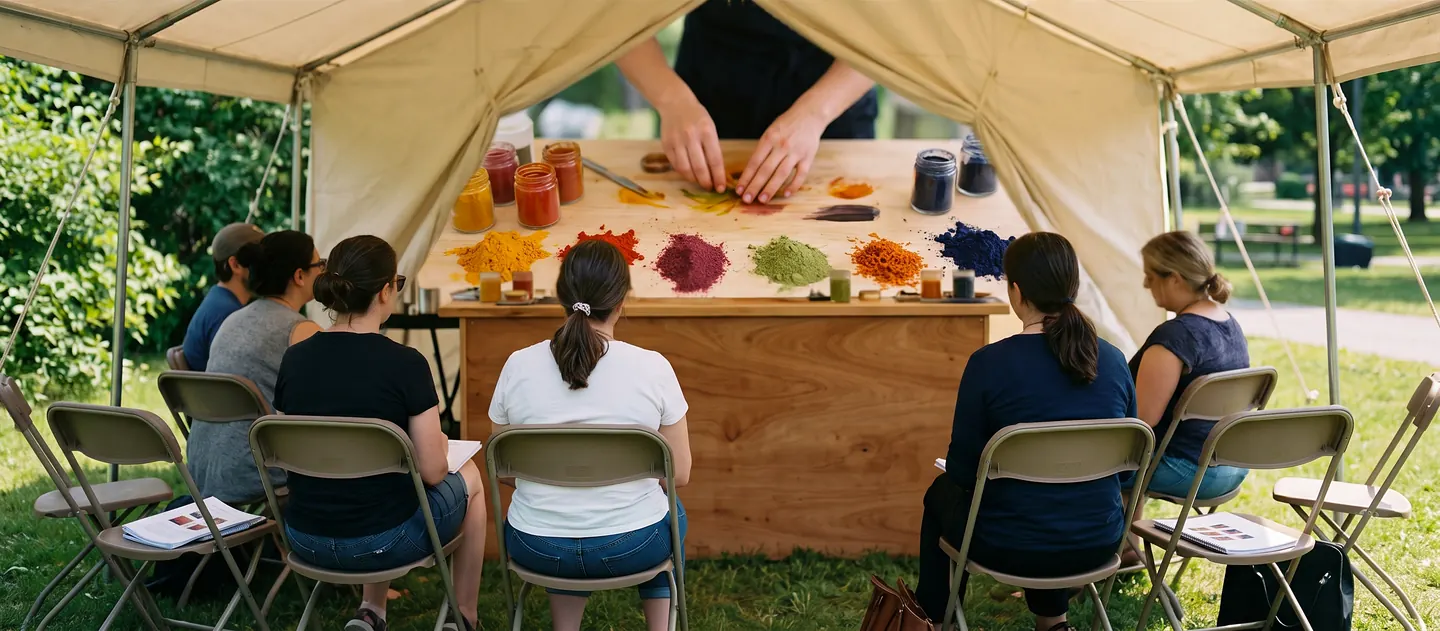
A workshop under an open canvas tent: seven people on folding chairs watching a demonstrator's hands over a bench spread with heaps of turmeric, chilli, sumac, matcha and indigo pigment and jars of dye.
A bench, a demonstration, and seven people who will work the field

Five courses.

Each one answers to something concrete — a regulation, a policy condition, or twenty emails that arrive every year asking the same thing. Read them as the syllabus we are writing to.

Planned · opening winter 2027

Course 01 and course 02 carry legal weight · course 03 is a condition of our cover

01

Event accessibility

Ontario law puts this one on everybody. The Integrated Accessibility Standards Regulation s.7(1) requires accessibility training and Human Rights Code training for employees and volunteers, as soon as practicable and in proportion to what the person does. The course covers service animals, support persons, the quiet zone, how to offer help and how to hear no, and what to do the moment someone cannot get where they are going.
02

Handling food on a field

Cooking happens in an approved kitchen. What happens on the field is reheating, holding, final assembly and service, and a certified food handler stands at the point in every operating hour it trades. Our course teaches our site — temperatures on a hot August field, handwash stations, the run from kitchen to pitch, what Ottawa Public Health asks for and when it has to be in.
03

Safety on the ground

Public liability cover of $2,000,000 is required of us by the Province of Ontario, the City of Ottawa and the National Capital Commission, each named on the policy. The emergency plan filed with the site application names who has been briefed. This is that briefing: build and strike, vehicles on a live site, gas and power, weather calls, where the exits are, who has the radio and the words that stop everything.
04

How a pavilion actually works

Written for a community doing this for the first time. Nine operating hours a day, five of them programme, both days, with the sun down at 20:24 on the Saturday. A coordinator and a deputy reachable all day. An exhibition with interpretation in English and French, a schedule of hosted talks, demonstrations by people who make the thing. Your certificate of insurance names the City of Ottawa. Your takings stay with you and the pavilion fee is zero, which is the part everyone asks about first.
05

Selling on the marketplace

For makers and shops listing on the marketplace. The first stage of that marketplace is a shopfront: your card, your photographs, your words, and an enquiry that turns into a conversation you close yourself. The course covers writing a card that gets opened, photographing work on a kitchen table, what our moderation looks for, and where our responsibility stops.

Who takes what, and how long it takes.

Lengths are the ceilings we are writing to. A course is finished when it teaches the thing, and the real length gets published the week it opens.

Proposed · winter 2027

A wide paved path through a park at sunset with a tactile strip down the centre, a person pushing another in a wheelchair, a water station with stacked cups on a barrel, and an open-sided rest tent with cushions under the trees.
A tactile strip down a park path, a water station and an open rest tent
The participant academy, planned intake 2027
CourseWho it is forPlanned length
Event accessibilityEveryone with a role — crews, vendors, volunteers, performers, our own teamUnder 40 minutes, online
Handling food on a fieldAnyone working a food point in a pavilion or a vendor pitchAbout an hour, plus your own certification elsewhere
Safety on the groundEveryone on site during build, show days and strikeAbout 30 minutes, plus a walk of the site on build day
How a pavilion actually worksPavilion coordinators and their deputies, one per community minimumTwo sittings, with a workbook you fill in for your own pavilion
Selling on the marketplaceSellers listing goods or servicesUnder 30 minutes, online

Every course ends the same way: a pass, dated, recorded in your account and kept there for the next edition and the one after that. Four of them leave something else behind as well. The food course holds your food handler certificate beside the pass. The safety course is the one a badge cannot be issued without. The pavilion course hands you a filled-in plan for your own pavilion. The marketplace course opens your shopfront.

A badge is issued on two things. Training passed, documents filed. That is the whole gate.
Accreditation rule of record · Capital Cultures, August 2026

How it gets recorded.

One account per person, opened when an application is accepted. It holds the courses your role needs, the documents your role needs, and the badge request. Six steps, in order, none of them optional.

Account opens winter 2027

01Planned Application in
02Planned Account opens
03Planned Courses set
04Planned Courses passed
05Planned Papers filed
06Planned Badge issued

Every box on this strip: planned

A role is assigned on an accepted application rather than by signing yourself up, so the courses you see are the ones you actually need. Pass one and the record is permanent — it stays in your account for the next edition, and for the edition after that.

Ontario asks organisations of fifty employees or more to keep a training log. We keep one from the first day, at any size, because the same log is what a funder, an insurer and a City officer each ask to see, and assembling it afterwards from memory is how organisations fail that question.

The order of things.

Dates that belong to a regulator are firm. Dates that belong to us are our plan, and every one of them depends on the site application landing.

All 2027 entries planned

  1. Autumn 2026Now Courses written Content drafted against the IASR, the City of Ottawa Special Events Guide, and what Ottawa Public Health asks of a special event.
  2. Winter 2027Planned Academy opens with the applications Vendors, volunteers, performers and the academy open in the same wave. The waiting list is called first.
  3. Spring 2027Planned Marketplace course opens with the shopfronts The marketplace starts as a catalogue of cards with the deal closed off site.
  4. July 2027Planned Accessibility training across the whole corps Everyone with a role, our own team included, before the site opens.
  5. 24 July 2027Planned Food vendor filings due to Ottawa Public Health Each vendor files their own, two weeks ahead, at no charge.
  6. Two weeks outPlanned Badge requests close Issued on training passed and documents filed. Late requests wait for the next edition.
  7. 7–8 August 2027Planned The two days Nine operating hours each day, five of them programme. Sunset on the Saturday is 20:24.

Questions.

Seven that arrive most often. Anything missing goes in the waiting list form below and gets answered there.

Answers change · the date on each change is published

Can I take a course now?

The courses open in winter 2027, alongside the vendor, volunteer and performer applications. Writing them properly takes the autumn, and every one of them has to be checked against the rule it answers to before anybody sits it.

The waiting list on this page is open today. People on it hear first, in the order they signed up, and they get asked what the courses are missing while there is still time to add it.

Does a course cost anything?

Our courses are free to anyone with a role at the festival. They are part of taking part, and charging for them would price out exactly the volunteers we need.

One thing sits outside that. A food handler certificate comes from a recognised provider rather than from us, and providers charge their own fee. We publish the list of certificates Ottawa Public Health accepts when the food course opens, so nobody pays for the wrong one.

Which courses are compulsory?

Accessibility training is required by Ontario law for employees and volunteers alike, so it applies to every single person with a role, including us.

The food course applies to anyone working a food point, because a certified food handler has to be at that point in every hour it trades. Safety on the ground applies to everyone who sets foot on site during build, show or strike.

The pavilion course and the marketplace course are ours. They exist because the same twenty questions arrive by email otherwise, and answering them once, properly, is better for everybody.

I already hold a food handler certificate. Do I sit the course?

Yes, and it is short. Your certificate covers food safety; our course covers this field — where the handwash stations stand, how far the run is from the kitchen, what the temperature log looks like on our paperwork, and who to find when a fridge dies at two in the afternoon.

Upload the certificate to your account and it sits with the record of the course.

What is the badge, exactly?

A named pass that opens the zones your role needs — your pavilion, the participants' area, the service gate, backstage for performers, the load-in for vendors. Multi-day roles carry a photograph on the badge.

It is issued on two conditions, and both are hard: the training for your role is passed, and the documents for your role are filed. Requests go in through the account two weeks before the event.

Will the courses run in French?

That is the plan, and the French site is being built as a full mirror rather than a summary. Until it exists, this page says so plainly instead of linking you to a page that is not there. Tell us on the waiting list which language you want to be taught in and it goes into the build order.

Who writes them?

We do, with the people whose rules they carry. Accessibility content is written against the Integrated Accessibility Standards Regulation and the City of Ottawa Special Events Guide. The food course is written against what Ottawa Public Health asks of a special event. The safety course is written against the emergency plan that goes in with our site application.

Where a course is still open — content, length, the check at the end — the page says so on the day it changes.

Join the waiting list.

One form, thirty seconds. It puts you in the first intake, tells us which courses to write first, and gets you an email the week they open.

Open today · intake 01 · winter 2027

Leave it empty if you are coming as an individual.
Courses you want first Tick as many as apply. This sets the order we write them in.
The French mirror of the site is in preparation. Answering French here counts as a vote for how fast it gets built.
The thing you would want explained before your first day on a festival site. We answer every one of these.
What you agree to hear from us Canadian anti-spam law asks for consent per mailing type, so we ask per type. One click unsubscribes, any time.

Joining the list commits neither of us to anything. It reserves your seat in the first intake and it shapes what gets written first.

An information booth under a saffron-draped canopy at dusk with a corded telephone, stacks of leaflets and a folded plan on the counter, the crowd and blurred lights of the festival behind.
An information booth under a canopy, a telephone and leaflets on the counter