The people who cook it own it. Pavilion kitchens run the length of the street, the craft row faces them across the walkway, and every pavilion serves one small tasting plate at the same fixed price, so a family can eat across four continents in an afternoon. Every dollar taken over a pavilion counter stays with the community that earned it.
Communities that already cook in this city · no community has been asked yet and no pavilion is confirmed
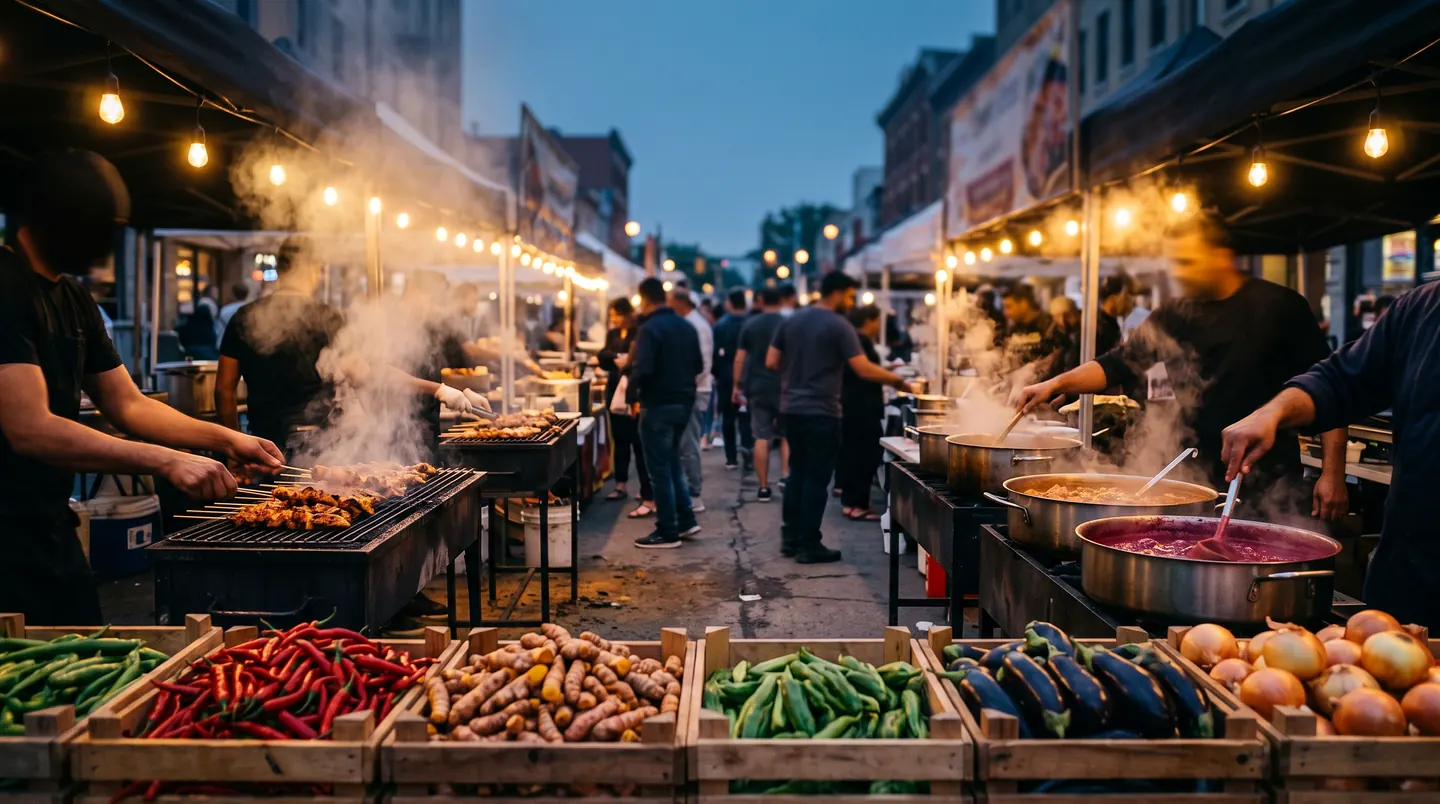
Two facing rows of stalls at dusk, skewers over charcoal and crates of chillies, ginger and aubergines along the front
Two rows, one street.
Community kitchens end to end, paid vendor pitches filling the hours the kitchens leave open, and the makers facing them from the other side of the walkway.
Planned layout · the site map publishes in spring 2027
How we intend to build it · 2027 would be the first edition
01
Pavilion kitchens
A community cooks under its own name and writes its own menu. The pavilion fee is zero and the counter's takings are the community's, in full.
02
Vendor pitches
Traders pay a flat rate up front and bring their own crew. They cover the hours a pavilion kitchen leaves open — coffee at nine in the morning, ice cream at four in the afternoon.
03
The craft row
Makers who make the object with their hands: embroidery, pysanka, weaving, ceramics, jewellery, instruments. Resale is refused at the jury stage.
04
One approved price list
Every dish on the field goes on a single list, checked and published before the gates open. The same plate costs the same at both ends of the street.
05
The tasting plate
A small plate at one fixed price in every pavilion, so a family can eat across four continents in an afternoon. Its price lands with the menus.
What lunch costs, and how you pay.
Cards at every counter, one approved list for the whole field, and the money going straight to the people who cooked.
Our own prices publish spring 2027 · the figures below belong to another festival and say so
Cards at every counter. Community pavilions already run their own card readers, and the festival puts nothing between you and them.
Cash still works. Small notes move a queue faster than anything else on a field.
Money goes straight across the counter — no scrip, no food tickets, no tokens. Edmonton ran a ticket currency for decades and dropped it once pavilions could take cards themselves.
One approved price list, published before the gates open and held to on the day.
Walking in is free. Whatever you spend on the field goes over a counter.
100%
Of a pavilion counter's takings stay with the community
The pavilion fee is zero. Food, drink and souvenirs are the community's entire revenue, and the festival takes no share of any of it.
Decision of record · community terms
Water, shade, and a dry first year.
Drinking water is free and easy to find. The first edition serves no alcohol, and the money that decision saves goes into the food street.
01 · water
Free at the tap
Refill points and taps go onto the site map before anything else does, and they cost nothing to use. Bottled water is sold at one price set by the festival, the same at every counter on the field, so nobody pays more for being thirsty at the far end of the street.
Bring a bottle. Refill points are marked on the map and free to use.
Shade and seating sit beside the water, together with the quiet zone for anyone who needs the noise to stop for ten minutes.
The first edition serves no alcohol. Alcohol doubles the sanitation requirement on a site this size, adds a mandatory police sergeant to every hour and a liquor layer to the insurance. Year one spends that money on the street instead.
15 → 31Toilets required per 1,000 people on site at once, dry against licensedANSI/PSAI Z4.4-2025, nine-hour day · Portable Sanitation Association International · the sanitation standard our budget is built on
$0Cost of a refill at a water pointOur commitment for the first edition
Allergies, and eating by your own rules.
The person who cooked the dish is standing at the counter. Ask them: they know what went into it.
Every counter can tell you what is in the dish, because the people serving it are the people who made it.
Halal, kosher, vegetarian, vegan and fasting-day dishes are labelled by the community that cooks them, in their own words, on the menu list and on the sign at the counter. The festival certifies nothing on their behalf and repeats no claim it cannot check.
Allergen information sits beside every dish on the approved list, which is why the list is written months before the gates open.
Nuts, sesame, dairy and gluten run through these kitchens. A separate fryer or a clean surface is a fair thing to ask for at the counter, and a straight answer is a fair thing to expect.
Can I eat across the whole street with a nut allergy?
Ask at each counter. Menus and their allergen lines publish in spring 2027, months ahead of the field, so the reading can be done at home. Every pavilion is briefed to answer plainly, including the answer “this one is not safe for you”.
Is the food halal?
Some of it. Each pavilion states what it serves and under whose rules, in its own words, and that line travels with the dish onto the published list. The festival carries no blanket certification for the field.
Who is allowed to cook, and where?
Cooking happens in an approved commercial kitchen. On the field a counter reheats, holds, assembles and serves, with a certified food handler on the point in every operating hour — those are Ottawa Public Health's rules for special events, and they apply to a pavilion exactly as they apply to a trader. A community without access to a commercial kitchen works through a restaurant partner or rents one for the weekend.
When do the menus publish?
Spring 2027, with prices, as one approved list for the whole field.
What a pitch costs in this city.
Our own rate is being set inside the corridor below and publishes with the vendor terms in winter 2027.
Published 2026 rates · three festivals in and around Ottawa
Pitch rates published for the 2026 season. Capital Cultures sets its rate inside this corridor and publishes it with the vendor terms.
Juried. A $2,000,000 insurance certificate naming the parties.
Swipe →
Power comes off the festival's own distribution and is sold by the outlet. Generators stay off the field.
The rate is flat and paid up front. A rained-out day stays the vendor's risk, and we say so before anybody signs.
A certified food handler stands on the point in every operating hour, which decides how many people a pitch actually needs.
Every food vendor files its own special-event application with Ottawa Public Health. The form is free and takes about two weeks; our packet deadline for the 2027 edition is 24 July 2027.
NowNowKitchens, one community at a timeFirst conversations about what a community would cook and who would cook it. A pavilion needs a year of lead time.
Winter 2027PlannedVendor and maker applications openTerms, requirements and the form live on Join → Vendors.
Spring 2027PlannedMenus, prices, site mapOne approved list for the whole field, and the map with the taps on it.
24 July 2027PlannedPublic health packet closesEvery food point on the field is permitted by then or it does not open.
7–8 August 2027PlannedThe street opensOur plan is 7–8 August 2027 at LeBreton Flats, subject to permits. Nothing is booked until the City and the NCC say yes, and this page says so the day it changes.
The craft row.
Everything on the row is made by the hands selling it, and every card on it leads back to a culture.
Juried · applications open winter 2027
Floss-silk star-flowers worked edge to edge, one corner turned back to the plain woven ground
02 · craft row
Made, then sold
Embroidery, pysanka, weaving, ceramics, jewellery, instruments. The jury asks one question of every application: did you make this? A card on the row carries the maker's name and their community, links to their shopfront on the marketplace, and the shopfront links to the article about the culture the craft comes from.
A craft pitch is smaller and cheaper than a food pitch. The Perth rate above — $78 a day for ten feet by ten — is the benchmark our own sits against.
The marketplace shopfront opens in spring 2027 and runs year round: a catalogue, a card per object, a message straight to the maker, and the deal made between the two of you.
Every card is moderated before it publishes. A row that fills with resale stops being a craft row inside a month.
Where to go next.
The street stands inside a field, beside a pavilion village, and the questions people send about eating here are answered on the last of these.
Festival · 03 of 07
Bring a kitchento the capital.
Communities cook first. Vendors cover the hours between. Makers face them across the walkway.