
Capital Cultures
Ottawa · Canada Get the lettersThe letters FR

Communities · 01 of 04 · what you get

Every dollar over your counter.

A community pavilion pays nothing to stand on this field and hands over nothing it earns. Everything below is what the festival carries so that your people can cook, perform and talk to a crowd.

Our plan for 7–8 August 2027 at LeBreton Flats, subject to permits

A queue in winter coats waiting at a lit food counter at dusk, a tray of cooked food steaming on the counter, an open cash box of notes and coins in the foreground and a server plating up behind.
An evening counter in the pavilion village

The counter is yours.

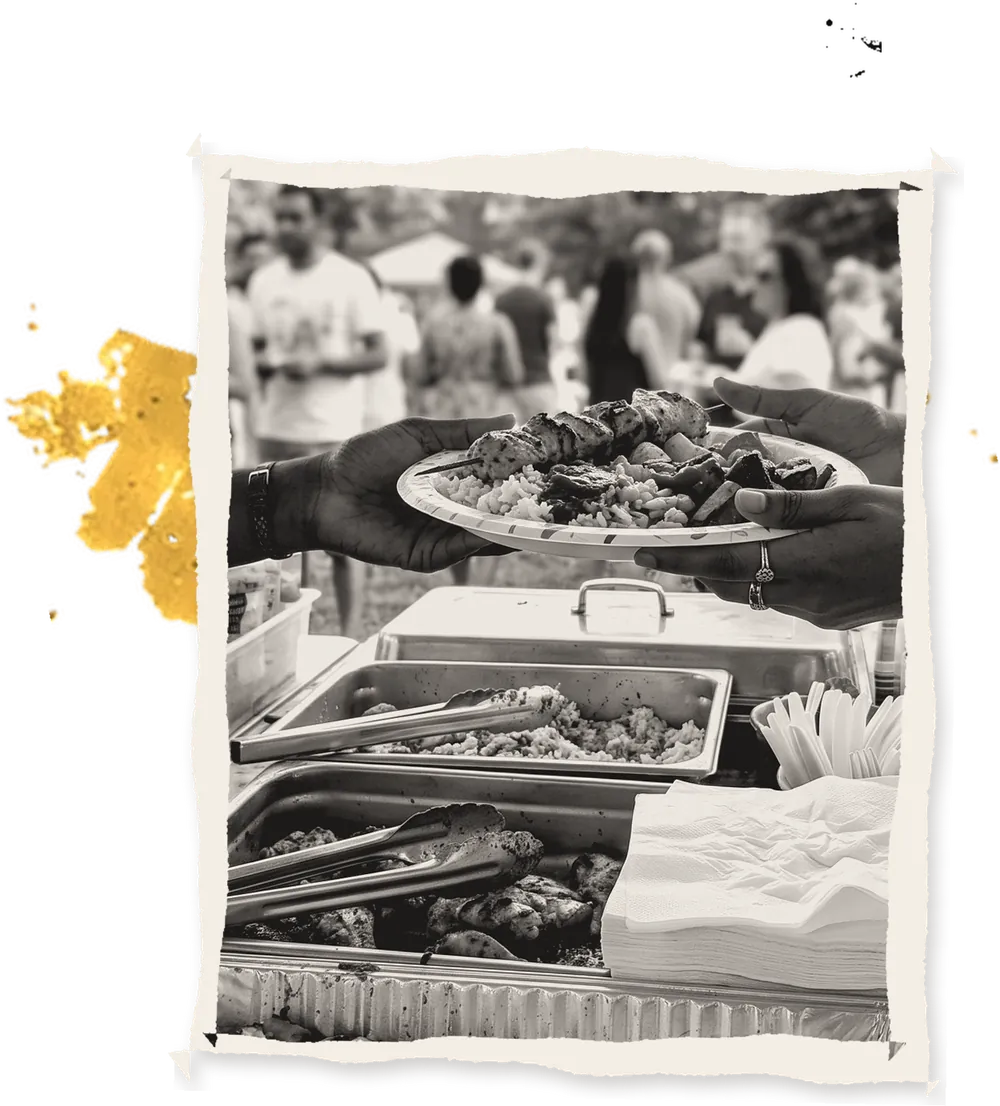
Food, drinks, souvenirs — every dollar taken over your counter across the two days stays with your organisation. The offer in one paragraph, the calendar and the four pages under it are on bring a pavilion; this page is the half of it the festival owes you.

Decision of record · 27 August 2026

100%

of pavilion takings stay with the pavilion

The festival earns from the commercial vendors it invites itself, from craft pitches, power, bottled water, the 50/50 draw, merchandise, grants and sponsors. Your kitchen sits outside all of it.

Organisers' decision of record, 27 August 2026 · a 20 % revenue share was costed and dropped

What the festival carries.

One production package covers the whole pavilion village. A community arrives with food, people and a programme and finds the rest of it standing.
Planned · first edition 2027

The aluminium frame of a marquee standing half built on the grass in morning light, folded indigo canvas stacked in the foreground, a clipboard and an enamel mug on a wooden crate, two workers in high-visibility vests walking away.
The frame of a marquee half up on the grass, canvas folded at the front

Sources · canon §5.3 and §5.5 · the tent line inside the production budget is still out for quotes

01

The ground and the permissions

The City event permit, the application to the National Capital Commission for LeBreton Flats, the site plan, the fire and emergency plans. The festival files them, pays for them and carries their deadlines.
02

The tent and everything under it

Tents, tables, chairs, fencing and food distribution arrive as one production package. A community operator books none of it and receives no invoice for it.
03

Power and water

Distribution across the village, with bottled water supplied centrally. How the outlets split between pavilions and commercial vendors lands with the site plan, ahead of the first invitation.
04

The fee for your performers

The working budget carries $800 for each community set on the main stage, plus $4,000 for two anchor acts across the weekend. Music licensing for the two days — SOCAN tariff 5.A and Re:Sound 5.D, $52.80 in certified rates — is paid centrally.
05

The crowd

The marketing campaign, the programme pages on this site, press work, listings and the encyclopedia article about your community. Named, because "marketing" on its own tells a board nothing: ethnic radio through CJLL-FM CHIN Ottawa, whose Ottawa language blocks cover twelve of the communities in this plan under one contract, and CKCU-FM 93.1, the one Ottawa community station with a published rate card and a thirty per cent discount for non-profits; French-language press and radio through Radio-Canada and Le Droit; the free listing calendars of Ottawa Tourism, which asks a month's notice from a non-member and translates the listing itself, and of the Ottawa Festival Network; and paid outdoor and transit. Your own channels stay yours, and the festival amplifies them.
06

Safety and the perimeter

Licensed security, police at the city's Tier 1 requirement, paramedics on site, by-law officers on noise, and the insurance the City and the NCC require of the event itself.
07

A person at the other end of the phone

A named coordinator at the festival office from the day you are accepted to the day the site clears, one operations manual, and a radio channel over the weekend.
08

Training, free

The participant academy opens in winter 2027 and costs an accepted pavilion nothing. Accessibility, food on a field, safety on the ground, and a course on running a pavilion for your coordinator and deputy.
All money made in the Pavilions, stays in the Pavilions.
Folklorama, Winnipeg · the second half of the formula in its own FAQ, quoted verbatim. The first half takes a percentage of admissions at the door; entry here is free, so that clause falls away and the rest of the sentence is ours.
Two facing rows of food stalls at dusk, skewers over a charcoal grill and a deep pot of red stew being stirred, steam rising into bulb light, crates of chillies, ginger, okra, aubergines and onions along the front.
The food street at dusk, skewers on the grill and crates of produce along the front

Why the zero holds.

A share of your counter was costed properly before it was dropped. The arithmetic is here because a promise a community cannot check is worth very little.

Organisers' decision of record, 27 August 2026 · estimates marked as estimates

A 20 % share of pavilion food, costed on ten pavilions over two days. Every line in this table is an estimate; the formula behind each one is named.
Line100 % to the community20 % share to the festival
Gross over ten pavilion counters≈$30,000≈$30,000
The festival's share, gross$0≈$6,000
Cost of collecting that share$0≈−$5,400
The festival's share, net$0≈$600
The community keeps, gross≈$30,000≈$24,000
The community keeps after food costs≈$19,500≈$13,500

The collection cost is the line that decides it. Folklorama's own audit shows what it costs to run money through a festival's payment loop: pavilion admission service fees of $249,600 against $1,393,210 collected, which is 17.9 per cent. The same proportion of $30,000 is $5,400, and $600 a year is less than four craft pitches bring in at $78 a day.

The second argument is plainer. GreekFest, the Ottawa Lebanese Festival and Italian Week have each been running for decades, and the Capital Ukrainian Festival takes municipal support. Every one of those communities already keeps the whole of its own kitchen. An unknown brand asking for a fifth of it in its first year would be told no, and rightly.

17.9% What collecting a share of the counter costs Folklorama audit · pavilion admission service fees $249,600 on $1,393,210 collected. Verified 27 August 2026
$13,136 Average paid out to each Folklorama pavilion in 2025 Folk Arts Council of Winnipeg · $564,834 shared across 43 pavilions. Their festival, their number

What that is, per pavilion.

One pavilion's share of the table above, and the part of the offer that arrives without passing through a till. Every money line is a planning estimate.
LineOne pavilion, first edition
Gross over your own counter≈$3,000 at 10,000 visits over the two days, the middle of the festival's target of 8,000 – 12,000. The target is the size the event is being built to fill, and this line moves with the count taken at the gates in August 2027.
What you keep after food costs≈$1,950, on the same 10,000 visits and the same assumption about ingredient cost.
The pitch, the tent, the tables, the fencingCarried by the festival. A community operator receives no invoice.
Power and water distributionCarried by the festival.
Your performers on the main stage$800 per community set from the festival budget, plus the music licence for the two days.
The academyFree to every accepted pavilion, four courses.
The article about your communityWritten with you, published under your name, and it stays up all year.
A shopfront in the marketplaceOpen the eleven months the field is empty.
Marketing, press and listingsThe campaign named in the row above, plus the programme pages on this site.

Questions a board asks.

The ones that come up before a vote. Anything missing goes to the festival office and gets answered here.

hello@capitalcultures.com

What does the weekend actually cost us?

Your ingredients, your insurance certificate, your crew's time, and whatever you choose to spend decorating your own tent. The pitch, the structure, the power, the stage fee for your performers and the music licence come from the festival. The counter pays you back.

Is there a fee later, once the festival grows?

A share of pavilion food returns to the agenda only alongside paid entry, and the first edition is free at the gate. A symbolic annual licence is discussed separately and its price is unset; when it is set, it appears on this page with the number in it.

Who pays if it rains?

The festival carries the site, the structure and the permits either way. Your exposure is the food you bought. The reserve weekend we are asking the NCC to write into the agreement is 21–22 August 2027, and it is fixed only once the permit fixes it.

Do we have to sell anything at all?

A pavilion can run on programme and exhibition alone. The kitchen is where most communities make their year, so most take it, and the tasting portion on the shared list is the one thing every pavilion serves.

What does the festival get out of us?

A reason for anybody to come. Roughly seventy community organisations run in this city by our count, and a weekend that puts a dozen of them on one field is the whole product. Your audience arrives with you, and that is the exchange.

Put your community on the list.

A first pass takes ten minutes and commits neither of us. Somebody from the festival office answers every application.