01
A kitchen that clears the law
Cooking from raw happens in an approved commercial kitchen. The stand on the field reheats, holds, assembles and serves.
Journal · Stories · 28 September 2026 · nine minutes
A community pavilion is a stand that a community's own non-profit runs inside a multicultural festival: its kitchen, its programme, its exhibition and its name over the door. At Capital Cultures the pavilion fee is $0 and every dollar over the counter stays with the community. In return the community brings an approved kitchen, $2 million in liability insurance, a bilingual exhibition and its own crew. This guide covers the whole job, the money, and the federal funding windows for 2027.
Written by the Capital Cultures organisers for community boards
A community pavilion is one community's own space inside a shared festival, operated by that community's non-profit. It sells food, puts on a programme and teaches visitors something through an exhibition, all under the community's name.
The pavilion model · Folklorama, Carassauga, Capital Cultures
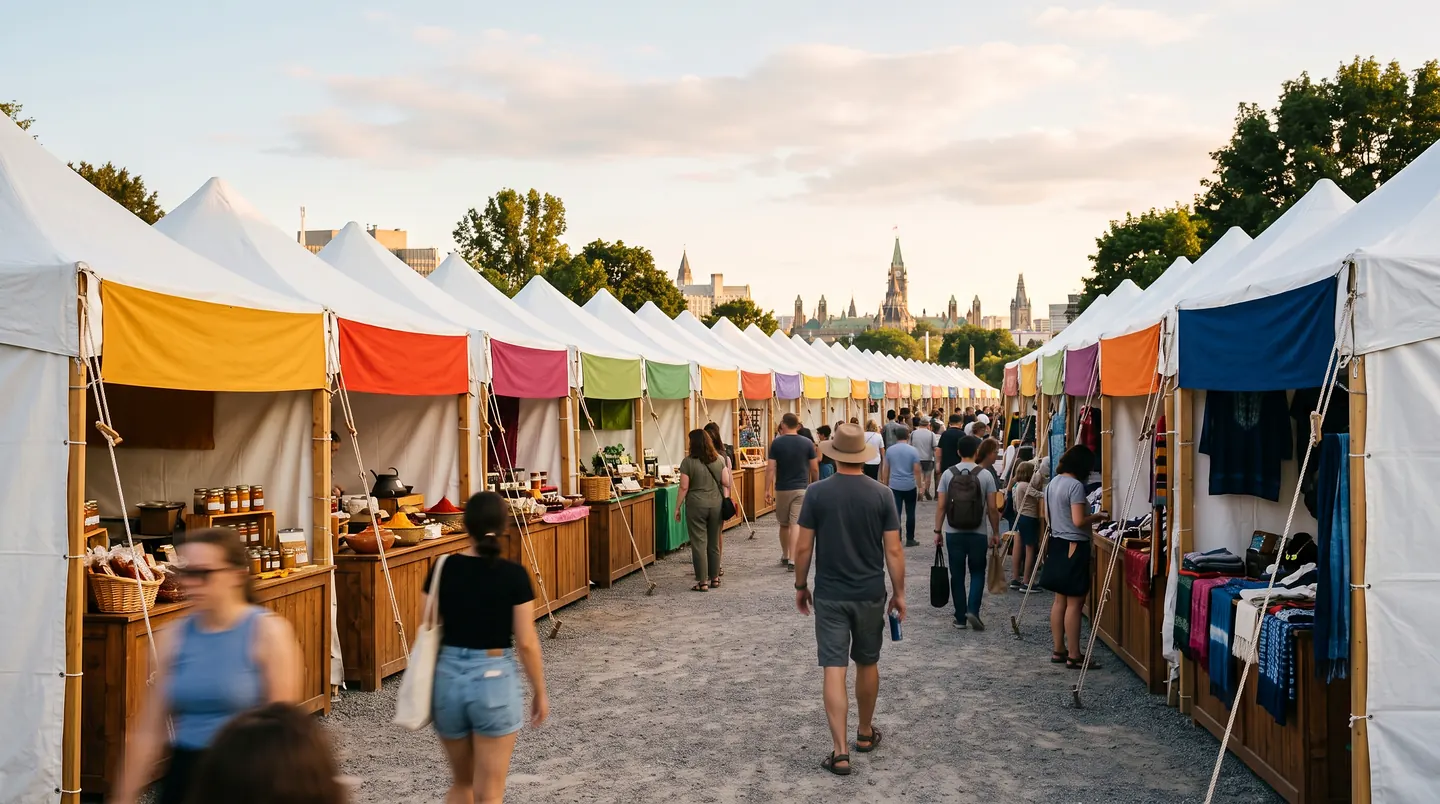
Folklorama in Winnipeg and Carassauga in Mississauga are built this way. Capital Cultures takes the same shape for Ottawa, and the choosing process is adapted from Folklorama, whose formula has held for fifty-five seasons.
Three rules define who stands on the field. The operator is an organisation incorporated as a non-profit in Ontario, with a majority of its board living in the Ottawa region. Diplomatic missions, government agencies and political organisations stay off the operator list, and a mission comes in as a programme partner sending an artist or an exhibition, or as a sponsor (the embassies page sets out the three levels). And the pavilion belongs to the community, so a restaurant can lend its kitchen while the community organisation stays the name on the agreement.
The operational detail of the model, as we propose it, is on how pavilions work.
The festival carries the ground, the structure, the power, the safety and the crowd. The community carries the food, the people and the programme.
Published terms · first edition, as planned
| Part of the pavilion | Carried by | Notes |
|---|---|---|
| Pitch, permits, site and emergency plans | Festival | Filed and paid by the festival |
| Tent, tables, chairs, fencing | Festival | One production package, no invoice to a community operator |
| Power distribution and bottled water | Festival | Supplied centrally |
| Security, paramedics, event insurance | Festival | The insurance the City and the NCC require of the event itself |
| Marketing, listings, an encyclopedia article | Festival | Your own channels stay yours |
| Main-stage fee for a community set | Festival | $800 per set in the working budget, music licensing paid centrally |
| Training for the crew | Festival | The participant academy, free to accepted pavilions |
| Kitchen, ingredients, menu | Community | Approved kitchen, certified food handler |
| Liability insurance certificate | Community | $2,000,000, City of Ottawa as Additional Insured |
| Crew, coordinator and deputy | Community | Recruited and briefed by the community |
| Programme and exhibition | Community | Exhibition interpreted in English and French |
A pavilion runs on eight obligations, all written into the participation agreement. Each one costs the community's people time before it costs anybody money.
Participation agreement · operator obligations
Source · /join/communities/duties/ · organisers' decision of record, 27 August 2026
Kitchen access has the longest lead time of the eight. Ontario food law sets the rule, and communities clear it in one of two ways every year across Canada: a restaurant inside the community lends its kitchen, its certificate and its cooks, or the group rents commercial kitchen hours by the block. The festival office helps a pavilion find one, and the booking is the community's.
pavilion fee · 100% of the counter to the community
Food, drinks, souvenirs: every dollar a pavilion takes over its counter stays with the community that built it. A 20% revenue share was costed and dropped, because it would have netted the festival about $600 a year and taken a third of the community's reason to come.
Capital Cultures · organisers' decision of record, 27 August 2026
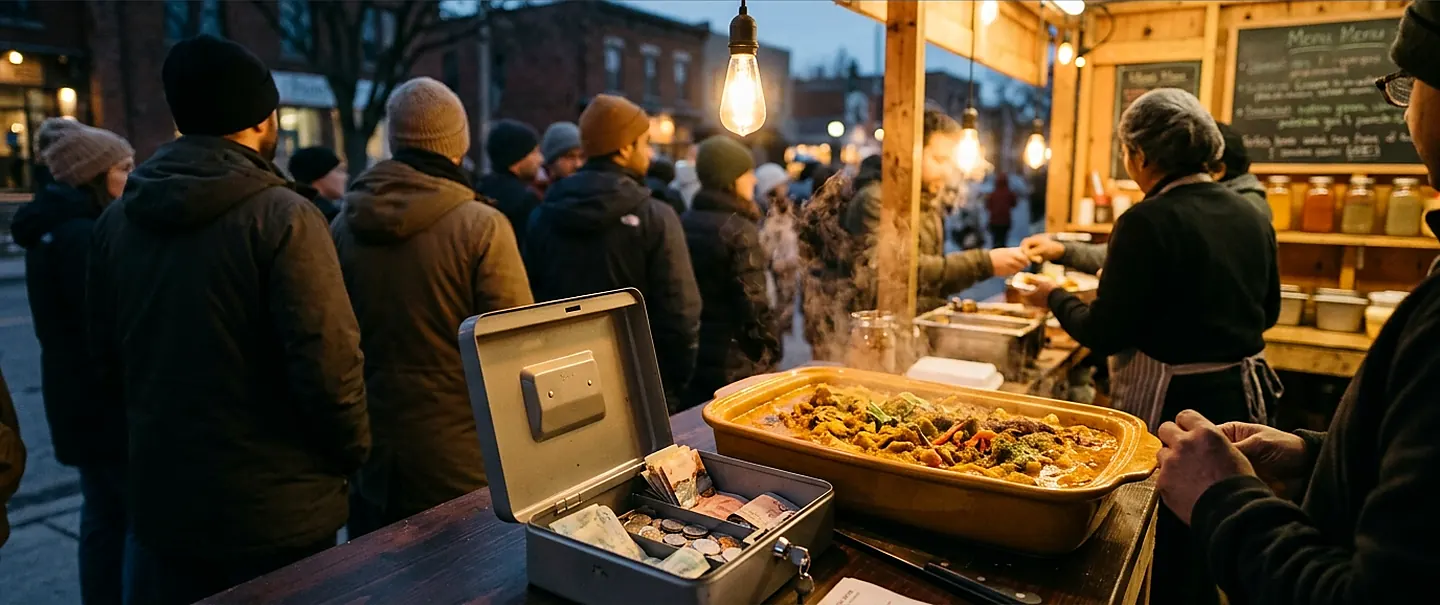
A pavilion needs two named leads, a certified food handler on every shift, and a crew sized to its menu. The crew is usually larger than a board first guesses, and the size of the crew predicts success better than any other answer on the application.
Roles drawn from the festival's operator obligations
| Role | What the person does |
|---|---|
| Pavilion coordinator | Runs the pavilion, holds the phone, briefed on the incident ladder |
| Deputy coordinator | Same briefing, covers every hour the coordinator is away |
| Certified food handler | On the stand every operating hour |
| Kitchen and serving lines | Reheat, hold, plate and serve; take payment |
| Programme lead | Performers, running order, the five hours of programme a day |
| Exhibition and interpretation | Panels and objects, English and French text, answering visitors |
| Build-day crew | Dresses the stand before gates open and runs the briefing |
Count a build day, the operating days in shifts, a kitchen line, a serving line, and two leads who do nothing else. A small crew with a short menu works well: three dishes done properly beat nine done in a panic. The participant academy covers accessibility, food on a field and safety on the ground for the whole crew, and a course on running a pavilion for the coordinator and deputy.
A pavilion's costs are ingredients, kitchen hours, the insurance certificate, crew time and dressing the stand. Its income is the counter. For the program and exhibition side, the federal Multiculturalism and Anti-Racism Program (MARP) funds public intercultural events in 2027 through three intakes.
Canadian Heritage · MARP Events component, read 28 September 2026
The pitch, the tent, the power, the water and the main-stage fee for a community set come from the festival.
Food and beverages, capital costs and anything spent before the application arrives are ineligible (application guidelines).
| Event dates | Apply between | Fits |
|---|---|---|
| 1 April – 31 July 2027 | 15 September – 27 October 2026, 4 pm ET | Spring and early summer 2027 events |
| 1 August – 30 November 2027 | 13 January – 24 February 2027, 4 pm ET | Summer and early autumn 2027 events |
| 1 December 2027 – 31 March 2028 | 12 May – 22 June 2027, 4 pm ET | Winter events |
Canadian Heritage publishes a decision standard of 26 weeks for this program (decision standards). For a summer 2027 event applied for in the January–February window, the answer can arrive close to the event, so the pavilion's own budget should stand without it. Whether a community's part inside a larger festival qualifies on its own is Canadian Heritage's decision; the Ontario regional office answers at multiontario-ontariomulti@pch.gc.ca.
Our news item on the 2027 MARP intakes lists the documents to gather this autumn, and the funders page shows how the festival itself is financed.
A community needs about a year to build its first pavilion, and the last six months carry most of the deadlines. A MARP Events intake closes five to nine months before the event it funds, so a funding file goes in before this plan starts.
Counted in months before the event · our working plan for a first-year pavilion
Each one is written into the published terms, so a board can check it before it votes.
Published terms · capitalcultures.com
Short answers, each one taken from the published terms or from canada.ca.
hello@capitalcultures.com
A tent or stand run by one community's own non-profit inside a multicultural festival, with its own kitchen, programme and exhibition under its own name. Folklorama in Winnipeg and Carassauga in Mississauga are two Canadian festivals built this way, and Capital Cultures follows the same shape in Ottawa.
The pavilion fee is $0, and every dollar over the pavilion's counter stays with the community. The community pays for its ingredients, its kitchen arrangements, its insurance certificate and its crew's time.
Under the festival's terms, each pavilion carries commercial general liability of $2,000,000 with the City of Ottawa named as Additional Insured, and delivers the certificate before the event.
Food for public sale is cooked in an approved commercial kitchen. On the field the pavilion reheats, holds, assembles and serves, with a certified food handler on the stand every operating hour. Communities usually borrow a restaurant partner's kitchen or rent commercial kitchen hours.
The operator is always a local non-profit: an organisation incorporated in Ontario with a majority of its board living in the Ottawa region. A diplomatic mission joins as a programme partner or as a sponsor.
The MARP Events component funds public events that bring communities together, up to $100,000 per event. It can cover costs such as performer fees, volunteer support, liability insurance and translation, and it excludes food and beverages. Whether a community's part inside a larger festival qualifies is Canadian Heritage's decision, so ask the Ontario regional office first.
The application takes ten minutes and binds nobody. Tell us who you are and what you would cook, and a person from the festival office writes back with the committee's questions.
Written by the Capital Cultures organisers, 28 September 2026.
Sources: the festival's published pavilion terms on what your community gets, what your community takes on and the participation agreement; Canadian Heritage, MARP Events component; its application guidelines; Canadian Heritage decision service standards.
Version 1 · updated when the terms or the program rules change