
Cultures · South & East Asia
Vietnamese community in Ottawa.
10,085 Ottawa residents report Vietnamese origin and 6,155 were born in Viet Nam. In 1979 the city set out to sponsor 4,000 refugees from Southeast Asia.
Figures · Census 2021, Statistics Canada
The short answer.
Census 2021 counts 10,085 Ottawa residents of Vietnamese origin and 6,155 born in Viet Nam, ninth among the birthplaces of the city's immigrants. Vietnamese is the mother tongue of 6,590 people, and 8,485 can speak it. Most of the community came long ago: 460 people arrived from Viet Nam between 2016 and 2021.
All figures · Census 2021, Statistics Canada
Residents of Vietnamese origin
Alone or with other origins. Children born in Ottawa to Vietnamese families count in this figure, and stay outside the birthplace count.
Census 2021, Statistics Canada · ethnic or cultural origin, City of Ottawa
How the community got here.
The city's own record and the census tell the same story from two ends.
Arrival · three lines
Project 4000, 1979
In 1979, under Mayor Marion Dewar, Ottawa launched Project 4000 to bring 4,000 refugees from Southeast Asia to the city through private sponsorship, most of them Vietnamese. Groups of residents signed on as sponsors.
Historical Society of OttawaDecades in the city
6,155 Ottawa residents were born in Viet Nam, and 460 of them arrived between 2016 and 2021. Most of Vietnamese Ottawa has been here for decades, and its children are counted as Canadian-born.
Census 2021, Statistics CanadaPart of Southeast Asian Ottawa
Census 2021 counts 14,960 Ottawa residents as Southeast Asian, a category that holds Vietnamese, Cambodian, Laotian and Thai origins among others.
Census 2021, Statistics Canada
The language.
Vietnamese is tonal: one syllable changes its meaning with a rising, falling or broken tone. It is written in the Latin alphabet, with the tones marked above and below the letters.
Vietnamese · a rough guide, the tones come by ear
| Say | Sounds like | When you use it |
|---|---|---|
| Xin chào | sin CHOW | Hello, at any hour. |
| Cảm ơn | gahm UHN | Thank you. |
| Ăn cơm chưa? | an GUHM chuh-a | Have you eaten yet? A greeting as much as a question. |
| Ngon quá | ngon KWAH | Delicious. |
| Chúc mừng năm mới | chook MUNG nam MUH-ee | Happy New Year, said at Tết. |
| Hẹn gặp lại | hen gap LIE | See you again. |
The kitchen.
The Vietnamese table balances broth, rice, herbs and a dipping sauce, and every diner seasons the bowl at the table.
Five dishes · what they actually are
Phở
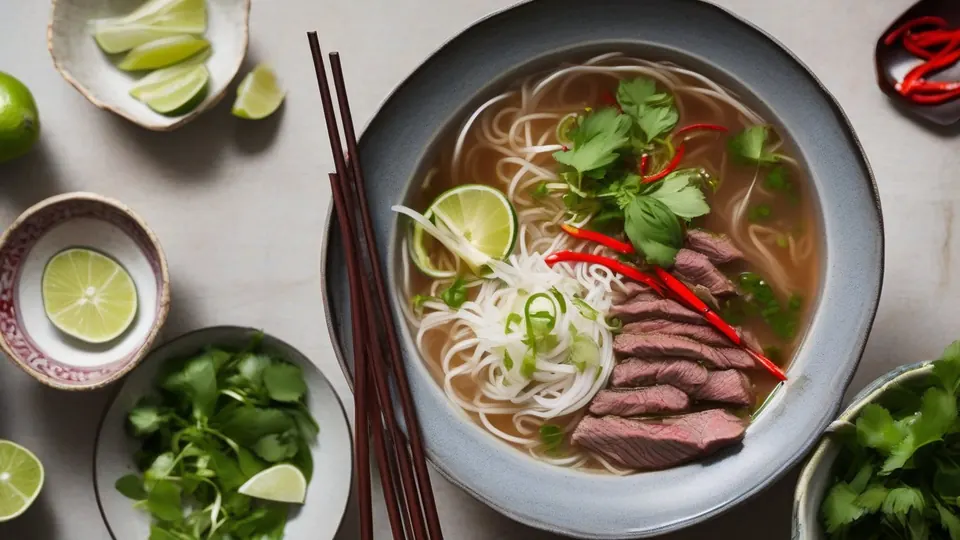
Rice noodles in a long-simmered beef or chicken broth, finished at the table with herbs, lime, bean sprouts and chili.
Bánh mì
A crisp baguette filled with pork or pâté, pickled carrot and daikon, cucumber, coriander and chili.
Gỏi cuốn
Fresh rolls: rice paper wrapped round shrimp, pork, noodles and herbs, dipped in peanut or fish sauce.
Bún chả
Grilled pork with rice vermicelli, herbs and a sweet-sour fish-sauce dressing. Hanoi's lunch.
Cà phê sữa đá
Strong drip coffee over sweetened condensed milk and ice.
The year.
The Vietnamese year runs on the lunar calendar, so every big date moves against the civil one. Christian families add the church year.
Fixed, lunar and moving dates
| When | What | How the date behaves |
|---|---|---|
| Late January or February | Tết Nguyên Đán, the Lunar New Year | Lunar. The largest celebration of the year; lucky money in red envelopes. |
| March or April | Hùng Kings' Commemoration | Lunar, the 10th day of the 3rd month. Honours the legendary founders of the country. |
| August or September | Vu Lan | Lunar, the 15th day of the 7th month. A Buddhist day of gratitude to parents. |
| September or early October | Tết Trung Thu, the Mid-Autumn Festival | Lunar, the 15th day of the 8th month. Lanterns and mooncakes; a festival for children, in the same season as Capital Cultures. |
| Christmas · Easter | Marked by Vietnamese Catholic families | Christmas is fixed; Easter moves every year. |
Where the community gathers.
A pagoda, a parish, a Saturday classroom and a noodle counter carry most of the weekly life.
Four kinds of place
Pagodas and parishes
Buddhist pagodas and Catholic parishes carry the weekly life: services, youth groups, weddings, funerals and the New Year.
Associations
Associations run the Tết dinners, the lantern walks of Mid-Autumn and the committees that carry the year from one celebration to the next.
Weekend schools
Saturday Vietnamese classes are how the language reaches children born here.
Noodle counters and grocers
A pho counter at lunchtime does part of the work of a community centre, whether or not anybody planned it that way.
At the festival.
A Vietnamese pavilion at Capital Cultures could pour coffee, roll gỏi cuốn and hang lanterns in the Mid-Autumn season. The community decides all of it.
First edition · September 2027 · free entry
- The kitchen decides the menu. Food, drink and souvenirs sold at a community pavilion stay with the community in full, and the pavilion fee is zero.
- The stage is programmed by the community. We hold the schedule, the sound and the licences; the community holds who performs and in what order.
- A community festival and a pavilion here are separate things. Tết and the Mid-Autumn celebrations the community already holds stay entirely its own, and a pavilion in September takes nothing from them.
- 01The community sends the pavilion application (ten minutes)
- 02A person answers within ten working days
- 03The board reads the published terms
- 04Both sides sign the participation agreement
- 05The pavilion opens on the field, September 2027
Short answers.
What people ask about Vietnamese Ottawa, answered from the census and the community calendar.
5 questions
How many Vietnamese live in Ottawa?
Census 2021 counts 10,085 Ottawa residents of Vietnamese origin, alone or with other origins, and 6,155 born in Viet Nam, ninth among the birthplaces of the city's immigrants. 460 people arrived from Viet Nam between 2016 and 2021.
What was Project 4000?
Ottawa's plan of 1979, led by Mayor Marion Dewar, to resettle 4,000 refugees from Southeast Asia in the city through private sponsorship. Most of them were Vietnamese, and groups of residents signed on as their sponsors (Historical Society of Ottawa).
When is Tết celebrated?
Tết, the Lunar New Year, falls in late January or February, on the first day of the lunar year, so the civil date changes every year. The Mid-Autumn Festival, Tết Trung Thu, follows in September or early October.
How many people speak Vietnamese in Ottawa?
8,485 Ottawa residents can speak Vietnamese, 6,590 have it as their mother tongue and 4,115 speak it most often at home (Census 2021). Six phrases to say out loud.
Can the Vietnamese community run a pavilion at Capital Cultures?
Yes. Capital Cultures is a free two-day multicultural festival in Ottawa in September 2027. Each pavilion is run by a community: it plans its menu and stage, keeps what its counter takes, and pays no pavilion fee. A person answers every application within ten working days. How a community applies.
Write this page with us.
Corrections, additions, a family's arrival story, the name of the cook or the maker. The byline belongs to whoever does the work.