
Cultures · South & East Asia
Chinese community in Ottawa.
46,170 residents of Ottawa are counted as Chinese, and China is the city's largest immigrant birthplace with 20,320 people.
Figures · Census 2021, Statistics Canada
The short answer.
Census 2021 counts 46,170 Ottawa residents as Chinese, 4.6% of the population in private households. China is the largest birthplace of the city's immigrants, with 20,320 people, and third among the arrivals of 2016 to 2021. Mandarin is Ottawa's second non-official mother tongue with 22,155 speakers and Cantonese its fourth with 10,045.
All figures · Census 2021, Statistics Canada
Residents counted as Chinese
Fourth among the racialized groups the census counts in Ottawa, after Black, Arab and South Asian residents. Children born here to Chinese families are inside this count.
Census 2021, Statistics Canada · racialized groups, City of Ottawa
How the community got here.
The census fixes the order of arrival. The families who made the journey tell the rest.
Arrival · four lines
China leads the birthplace list
20,320 of the 259,215 immigrants living in Ottawa were born in China, more than in any other country. India follows with 16,200 and the United Kingdom with 14,760.
Census 2021, Statistics CanadaThe arrivals have not stopped
3,225 people born in China moved to Ottawa between 2016 and 2021, third among recent arrivals after India (5,645) and Syria (4,450).
Census 2021, Statistics CanadaTwo languages under one name
The census counts Mandarin and Cantonese apart: 22,155 and 10,045 mother-tongue speakers, 32,200 together. A Cantonese-speaking family from Hong Kong and a Mandarin-speaking family from Shanghai share a written language and a New Year, and order lunch in different words.
Census 2021, Statistics CanadaA community service centre since 1975
The Ottawa Chinese Community Service Centre opened in December 1975 to help newcomers settle, and it still does that work today.
The language.
Mandarin is the language of most newer arrivals, Cantonese the language of the older Chinese Ottawa and of many Hong Kong families. Six phrases, written so an English speaker can say them aloud.
Say it out loud · stress on the capitals
| Say | Sounds like | When you use it |
|---|---|---|
| Nǐ hǎo | nee HOW | Hello, in Mandarin. Works at any hour. |
| Xièxie | SHYEH-shyeh | Thank you, in Mandarin. |
| Chī le ma? | chir luh MA | Have you eaten? A greeting more than a question. |
| Xīnnián kuàilè | shin-nyen KWAI-luh | Happy New Year, in Mandarin. |
| Gung hei fat choy | gung HAY fat CHOY | The Lunar New Year greeting in Cantonese: wishing you prosperity. |
| M goi | mm GOY | Thank you in Cantonese, for a service: the tea poured, the door held. |
The kitchen.
Ottawa eats Cantonese food at a dim sum table and northern food at a dumpling counter, often in the same week.
Five dishes · what they actually are
Dim sum
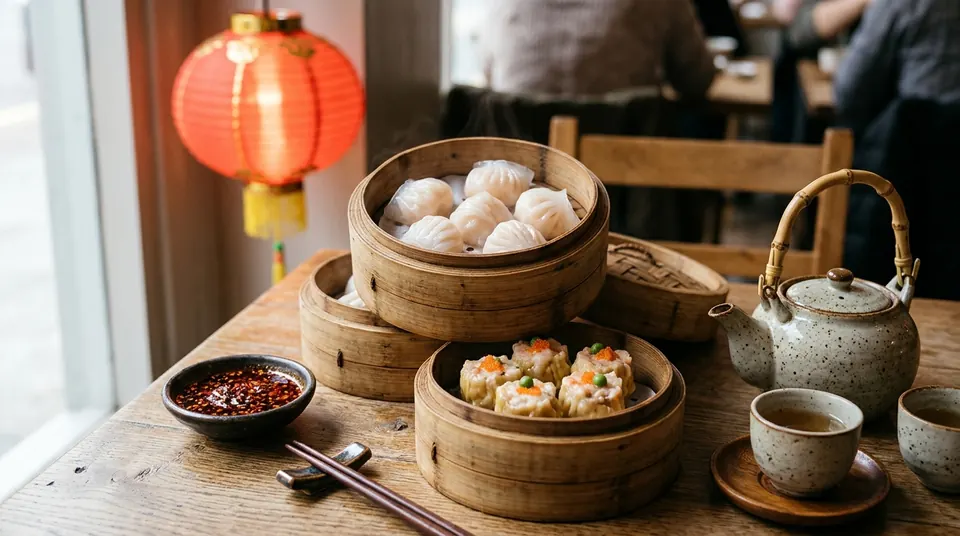
Small dishes in bamboo steamers, eaten over tea in the late morning: har gow with shrimp, siu mai with pork, char siu buns. The Cantonese call the meal yum cha, drinking tea.
Jiaozi
Boiled or pan-fried dumplings. Northern families fold them together on New Year's Eve, and the shape is said to look like old silver ingots.
Hot pot
A pot of simmering broth in the middle of the table, and everyone cooks their own thin-sliced meat, greens and tofu in it. A winter meal and a meal for a crowd.
Nian gao
Sticky rice cake for the New Year. The name sounds like «higher every year», which is the wish.
Mooncakes
Dense round pastries filled with lotus seed or red bean paste, often around a salted egg yolk, given and shared at the Mid-Autumn Festival.
The year.
The Chinese calendar in Ottawa runs on the lunar months, so its festivals move against the Gregorian year. Lunar New Year opens it in winter, and the Mid-Autumn Festival lands in September in most years.
Lunar and solar dates
| When | What | How the date behaves |
|---|---|---|
| Late January to mid-February | Lunar New Year, the Spring Festival | Lunar. In 2027 it falls on 6 February. Fifteen days of visits, red envelopes and family dinners. |
| Fifteen days later | Lantern Festival | Lunar. Closes the New Year with lanterns and sweet rice dumplings. |
| Early April | Qingming, tomb-sweeping day | Solar. Families tend graves and remember their dead. |
| May or June | Dragon Boat Festival | Lunar. Sticky rice parcels and boat races; Ottawa runs a dragon boat festival of its own. |
| September or early October | Mid-Autumn Festival | Lunar, the full moon of the eighth month. Mooncakes, lanterns and a family evening outside. |
Where the community gathers.
A service centre, a Saturday school, a church or temple hall and a row of restaurants carry most of the weekly life here.
Five types of place
Chinatown on Somerset Street West
Ottawa's Chinatown runs along Somerset Street West. Its restaurants, bakeries and grocers are where much of the city first tastes Chinese food.
The community service centre
Settlement help, language classes and senior programmes, in Mandarin, Cantonese and English, under one roof since 1975.
Weekend Chinese schools
Saturday classes are how the written language and a parent's dialect reach children born here.
Churches, temples and associations
Congregations, Buddhist temples, alumni and hometown associations run the dinners, the New Year galas and the committees that carry the year.
Music and dance groups
Chinese orchestras, lion-dance teams and dance schools rehearse all year for the New Year stage, and in 2024 the City of Ottawa's cultural funding went to a Chinese musicians' association among others.
At the festival.
Lunar New Year belongs to winter and to the community's own halls. A pavilion at Capital Cultures is a September weekend, the season of the Mid-Autumn Festival, and a smaller ask.
First edition · September 2027
- The kitchen decides the menu. Food, drink and souvenirs sold at a community pavilion stay with the community in full, and the pavilion fee is zero.
- The stage is programmed by the community. We hold the schedule, the sound and the licences; the community holds who performs and in what order.
- A community festival and a pavilion here are separate things. The New Year galas and the Chinatown events stay entirely the community's own, and a pavilion in September takes nothing from them.
From an application to a pavilion
- 01Apply on the community form
- 02A person answers within 10 working days
- 03Plan the menu, the stage and the craft table
- 04Run the pavilion in September 2027
Four steps from a first message to a pavilion on the field.
Short answers.
What people ask about Chinese Ottawa, answered from the census and the community calendar.
6 questions
How many Chinese live in Ottawa?
Census 2021 counts 46,170 residents of the city of Ottawa as Chinese, 4.6% of the population in private households. 20,320 of the city's immigrants were born in China, the largest birthplace of any country. Census 2021, Statistics Canada.
Is China the biggest source of immigrants in Ottawa?
Yes. China is first among the birthplaces of Ottawa's immigrants with 20,320 people, ahead of India with 16,200. Among arrivals of 2016 to 2021 China is third, with 3,225, after India and Syria. Census 2021, Statistics Canada.
How many people speak Mandarin or Cantonese in Ottawa?
22,155 people in Ottawa have Mandarin as their mother tongue, the second most common non-official mother tongue after Arabic, and 10,045 have Cantonese, the fourth. Census 2021, Statistics Canada.
When is Chinese New Year in Ottawa?
Lunar New Year falls between late January and mid-February; in 2027 it is on 6 February. Families mark it at home and in community halls for fifteen days, up to the Lantern Festival. The calendar of Ottawa's communities has every month.
Where is Chinatown in Ottawa?
Ottawa's Chinatown runs along Somerset Street West, west of downtown, with restaurants, bakeries and grocers. The Ottawa Chinese Community Service Centre has served newcomers since December 1975.
Can the Chinese community run a pavilion at Capital Cultures?
Yes. Capital Cultures is a free two-day multicultural festival in Ottawa in September 2027. Each pavilion is run by a community: it plans its menu and stage, keeps what its counter takes, and pays no pavilion fee. How a community applies.
Write this page with us.
Corrections, additions, a family's arrival story, the name of the cook whose table everyone queues for. The byline belongs to whoever does the work.