
Cultures · South & East Asia
Indian community in Ottawa.
16,200 people in Ottawa were born in India, and India sent more of the city's newest residents than any other country.
Figures · Census 2021, Statistics Canada
The short answer.
Census 2021 counts 16,200 Ottawa residents born in India, second among the city's immigrant birthplaces after China. India also leads recent immigration: 5,645 of the 47,415 people who arrived between 2016 and 2021, 11.9%. The census counts 57,820 residents as South Asian, a category that holds Indian, Pakistani, Sri Lankan and Bangladeshi origins together.
All figures · Census 2021, Statistics Canada
Born in India
Second on the city's immigrant birthplace list, behind China and ahead of the United Kingdom. Children born here to Indian families are counted as Canadian-born, so the community itself runs larger.
Census 2021, Statistics Canada · country of birth, all immigrants, City of Ottawa
How the community got here.
The census fixes the order of arrival. The families who made the journey tell the rest.
Arrival · three lines
Second on the birthplace list
16,200 of the 259,215 immigrants living in Ottawa were born in India, second after China (20,320) and ahead of the United Kingdom (14,760).
Census 2021, Statistics CanadaFirst among the newest arrivals
Between 2016 and 2021 India sent 5,645 people to Ottawa, more than any other country: Syria followed with 4,450 and China with 3,225. Much of Indian Ottawa arrived recently.
Census 2021, Statistics CanadaSouth Asian is the wider count
57,820 residents are counted as South Asian, the third racialized group in the city after Black and Arab residents. The category holds families from India, Pakistan, Sri Lanka, Bangladesh and Nepal, and Indian-born Ottawans are a large part of it.
Census 2021, Statistics Canada
The language.
India's constitution lists twenty-two languages, and Ottawa hears many of them: Hindi, Punjabi, Gujarati, Tamil, Telugu, Malayalam, Bengali, Urdu. Families keep their own and meet in English.
Say it out loud · stress on the capitals
| Say | Sounds like | When you use it |
|---|---|---|
| Namaste | NUM-us-tay | Hello, in Hindi and across the north. Said with the palms together. |
| Sat Sri Akal | sut sree a-KAAL | The Punjabi and Sikh greeting: truth is eternal. |
| Vanakkam | va-NAK-kum | Hello, in Tamil. |
| Kem cho? | kem CHO | How are you, in Gujarati. |
| Dhanyavaad | dhun-ya-VAAD | Thank you, in Hindi. |
| Shubh Deepavali | shubh dee-PAA-va-lee | Happy Diwali, written on the card and said at the door. |
The kitchen.
Indian food in Ottawa runs from the restaurant curry the whole city knows to regional kitchens that rarely make a menu: the southern breakfast, the Gujarati thali, the gurdwara's free meal.
Five dishes · what they actually are
Dosa
A thin, crisp crêpe of fermented rice and lentil batter from the south, rolled around spiced potato and served with sambar and coconut chutney.
Biryani
Rice layered with meat or vegetables and spices and cooked slowly under a lid. Hyderabad, Lucknow and Kolkata each claim the right way.
Samosa
A fried pastry triangle filled with spiced potato and peas. A tea-time snack, and the first thing to sell out at any community table.
Langar
The free communal meal of every Sikh gurdwara: dal, roti and rice, cooked by volunteers and served to anyone who sits down, on the floor, side by side.
Mithai
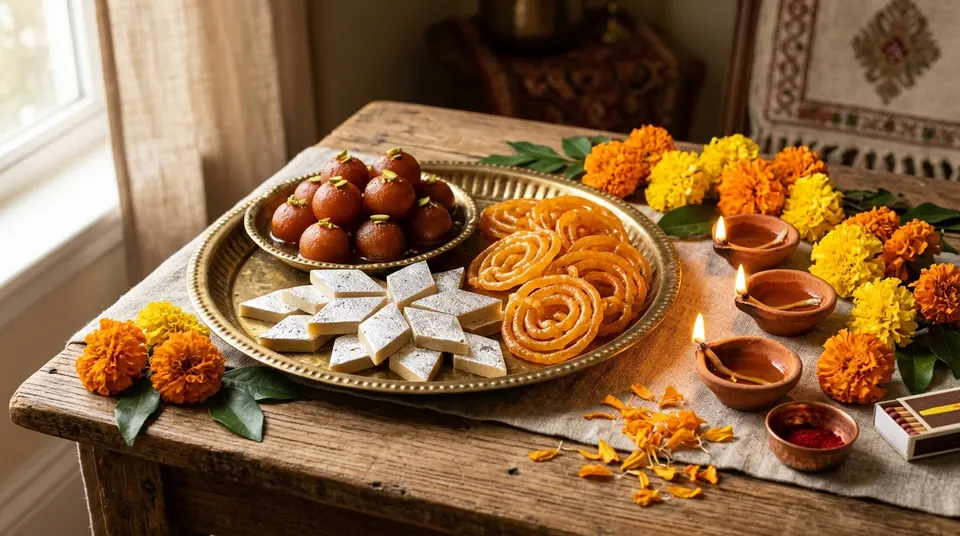
Sweets for every celebration: syrup-soaked gulab jamun, diamond-cut kaju katli, bright coiled jalebi. Boxes of them change hands at Diwali.
The year.
Indian Ottawa keeps two kinds of date: the civil days on fixed dates and the festivals of the lunar and solar calendars; the lunar ones change date every year, the solar ones return within a day. Diwali, the largest of them, lands in October or November.
Fixed, lunar and solar dates
| When | What | How the date behaves |
|---|---|---|
| Mid-January | Pongal, Makar Sankranti, Lohri | Solar. Harvest festivals of the south, the west and Punjab, around 13–15 January. |
| 26 January | Republic Day | Fixed. The constitution came into force on this day in 1950. |
| March | Holi | Lunar, the full moon of spring. Coloured powder and water, outdoors. |
| 13 or 14 April | Vaisakhi | Solar. The Punjabi harvest and the founding of the Khalsa, marked at every gurdwara. |
| 15 August | Independence Day | Fixed. Independence dates from 1947. |
| September or October | Navratri, Durga Puja, Dussehra | Lunar. Nine nights of garba dancing and the goddess's festival. |
| October or November | Diwali | Lunar, the new moon of Kartika. Lamps, sweets, new clothes and fireworks. |
Where the community gathers.
Temples, gurdwaras, mosques, churches and language associations carry most of the weekly life here, and a sweet shop does the rest.
Five types of place
Temples and gurdwaras
Hindu temples and Sikh gurdwaras hold the weekly prayers, the festival nights and the meals, and many run language and music classes in their halls.
Mosques and churches
Indian Muslim and Christian families keep their own calendars in the city's mosques and parishes.
Associations by language and state
Tamil, Telugu, Gujarati and Malayali associations and a Sikh society run the New Year, the harvest and the Diwali evenings, each in its own language. In 2024 the City of Ottawa's cultural funding went to a Tamil youth culture group among others.
Dance and music schools
Bharatanatyam, Kathak and bhangra schools train the children seen on the city's community stages.
Sweet shops and grocers
A counter selling samosas and boxed mithai the week before Diwali does part of the work of a community centre, whether or not anybody planned it that way.
At the festival.
The Great India Festival already runs in Ottawa, with City of Ottawa cultural funding in 2024, and belongs to its organisers. A pavilion at Capital Cultures is a different weekend in September and a smaller ask.
First edition · September 2027
- The kitchen decides the menu. Food, drink and souvenirs sold at a community pavilion stay with the community in full, and the pavilion fee is zero.
- The stage is programmed by the community. We hold the schedule, the sound and the licences; the community holds who performs and in what order.
- A community festival and a pavilion here are separate things. The Great India Festival, the Diwali evenings and the Vaisakhi processions stay entirely the community's own, and a pavilion in September takes nothing from them.
From an application to a pavilion
- 01Apply on the community form
- 02A person answers within 10 working days
- 03Plan the menu, the stage and the craft table
- 04Run the pavilion in September 2027
Four steps from a first message to a pavilion on the field.
Short answers.
What people ask about Indian Ottawa, answered from the census and the community calendar.
6 questions
How many Indians live in Ottawa?
Census 2021 counts 16,200 Ottawa residents born in India, second among the city's immigrant birthplaces after China. The figure counts birthplace only: children born in Canada to Indian families sit outside it, so the community itself is larger. Census 2021, Statistics Canada.
How many South Asians live in Ottawa?
Census 2021 counted 57,820 residents of the city of Ottawa as South Asian, 5.8% of the population in private households and the third racialized group in the city. The category holds Indian, Pakistani, Sri Lankan, Bangladeshi and Nepali origins. Census 2021, Statistics Canada.
Which country do most new immigrants to Ottawa come from?
India. 5,645 of the 47,415 people who moved to Ottawa from abroad between 2016 and 2021 were born there, 11.9% and the most of any country; Syria was second with 4,450 and China third with 3,225. Census 2021, Statistics Canada.
When is Diwali celebrated in Ottawa?
Diwali falls in October or November, on the new moon of the month of Kartika, so the date moves every year. Families mark it at home, in temples and at community evenings across the city. The calendar of Ottawa's communities lists them month by month.
Where does the Indian community gather in Ottawa?
Hindu temples and Sikh gurdwaras carry most of the weekly life, with mosques and parishes for Indian Muslim and Christian families. Tamil, Telugu, Gujarati and Malayali associations and a Sikh society run the festival evenings in their own languages, and dance schools train the children for every community stage.
Can the Indian community run a pavilion at Capital Cultures?
Yes. Capital Cultures is a free two-day multicultural festival in Ottawa in September 2027. Each pavilion is run by a community: it plans its menu and stage, keeps what its counter takes, and pays no pavilion fee. How a community applies.
Write this page with us.
Corrections, additions, a family's arrival story, the name of the cook whose table everyone queues for. The byline belongs to whoever does the work.