
Cultures · Africa
Somali community in Ottawa.
10,030 Black residents of Ottawa report Somali origin, the second most reported origin in the city's Black community.
Figures · Census 2021
The short answer.
Census 2021 tables prepared for Ottawa count 10,030 Black residents reporting Somali ethnic or cultural origin, second only to «African». 4,370 Black immigrants in the city were born in Somalia, second after Haiti, and Somali is the most common non-official mother tongue among Ottawa's Black residents. Origin counts children born here too, so it runs larger than birthplace.
All figures · Census 2021 · Social Planning Council of Ottawa
Report Somali origin
Second among the more than 150 origins Ottawa's Black residents reported, after «African» (12,885) and ahead of Haitian (9,320) and Jamaican (5,205).
Census 2021 · Social Planning Council of Ottawa · ethnic or cultural origins of the Black population, Ottawa
How the community got here.
The census fixes the timing. The families who made the journey tell the rest.
Arrival · three lines
Most of it happened before 2016
Of the 4,370 Black immigrants in Ottawa born in Somalia, 555 arrived between 2016 and 2021. Nearly nine in ten were already here before 2016.
Census 2021 · Social Planning Council of OttawaSomalia and Haiti lead the list
Among the birthplaces of Ottawa's 44,805 Black immigrants, Haiti comes first with 6,525, Somalia second with 4,370 and the Democratic Republic of the Congo third with 3,940.
Census 2021 · Social Planning Council of OttawaA young population
The Black population of Ottawa, 84,770 people, has a median age of 27.6 years against 39.2 for the city, and grew 40.8% from 2016 to 2021.
Census 2021, Statistics Canada
The language.
Somali is written in the Latin alphabet, adopted as the official script in 1972, so a sign in Somali can be read aloud by anyone who learns a few letters: c is a sound from the throat, x a breathy h, and a doubled vowel is held longer.
Say it out loud · stress on the capitals
| Say | Sounds like | When you use it |
|---|---|---|
| Soo dhawoow | soh DHAH-wo | Welcome. Said to a guest at the door. |
| Iska warran? | IS-ka WAR-ran | How are you? Literally, what is the news? |
| Nabad | NA-bad | Peace. Said as a greeting and as an answer. |
| Mahadsanid | ma-HAD-sa-nid | Thank you. |
| Haa · Maya | HAA · MA-ya | Yes · no. |
| Ciid wanaagsan | EED wa-NAAG-san | Happy Eid. Said on both Eids, to everyone. |
The kitchen.
Somali food carries the trade routes of the Horn of Africa: rice and spices from across the Indian Ocean, pasta from the Italian years, tea from everywhere.
Five dishes · what they actually are
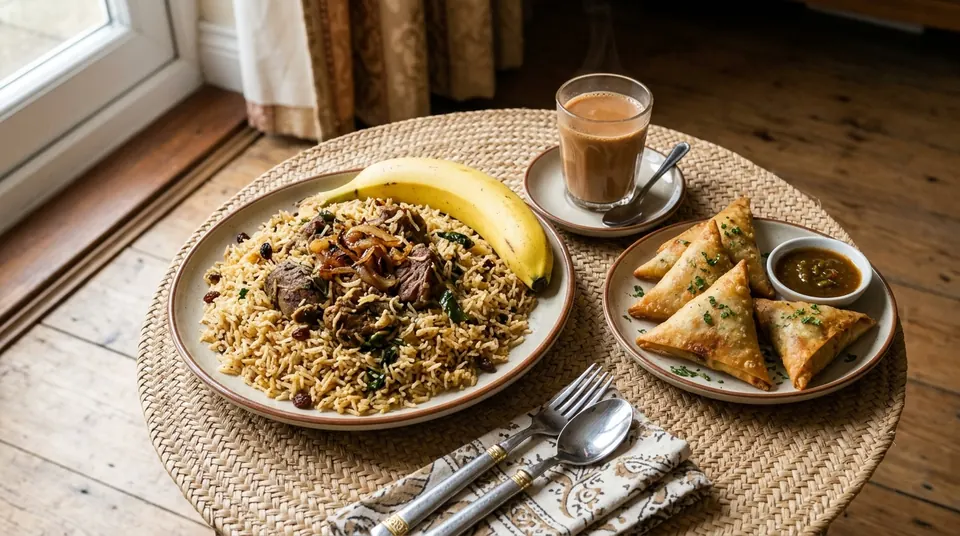
Bariis iskukaris
Basmati rice cooked with cumin, cardamom, cinnamon and cloves, served with goat or chicken, and with a banana on the side to eat alongside each bite.
Sambuus
A fried pastry triangle filled with spiced minced meat or lentils. Ramadan evenings start with a plate of them.
Canjeero
A thin, slightly sour pancake from a fermented batter, the Somali breakfast, eaten with sugar and tea, or with stew.
Suqaar
Small cubes of beef, goat or chicken fried quickly with onion, peppers and spices; eaten with rice, pasta or canjeero.
Shaah and xalwo
Shaah is black tea boiled with milk, cardamom, cinnamon and sugar. Xalwo is a dense, glossy sweet set in a tray and cut for weddings and Eid.
The year.
Somali Ottawa keeps two kinds of date: the lunar feasts of Islam, which move about eleven days earlier every year, and two fixed national days at the start of summer. The second of them falls on Canada Day.
Lunar and fixed dates
| When | What | How the date behaves |
|---|---|---|
| February to March 2027 | Ramadan | Lunar. A month of fasting from dawn to sunset; sambuus and dates break it each evening. |
| March 2027 | Eid al-Fitr | Lunar. Ends Ramadan: prayers in the morning, new clothes, visits and xalwo. |
| May 2027 | Eid al-Adha | Lunar. The feast of the sacrifice, at the end of the pilgrimage season. |
| 26 June | Independence of the north | Fixed. British Somaliland became independent on this day in 1960. |
| 1 July | Independence and union | Fixed. In 1960 the south became independent and joined the north. In Ottawa the day falls on Canada Day. |
Where the community gathers.
A mosque, a museum of the community's own, a Saturday class and a restaurant table carry most of the weekly life here.
Four types of place
Mosques and their community rooms
Friday prayers, Qur'an classes for children and the shared iftar tables through Ramadan.
A Somali cultural museum
The Khayrhaye Somali Cultural Museum keeps the objects and the heritage of the community in Ottawa, and in 2024 the City of Ottawa's cultural funding supported its work.
Associations and youth programmes
Community organisations, the Ottawa Somali Network among them, run the meetings, the youth evenings and the gatherings that carry the year from one Eid to the next.
Restaurants and grocers
A restaurant serving bariis with a banana on the side does part of the work of a community centre, whether or not anybody planned it that way.
At the festival.
Somali Ottawa celebrates 1 July twice over, and the Eid gatherings belong to its own halls. A pavilion at Capital Cultures is a September weekend and a smaller ask.
First edition · September 2027
- The kitchen decides the menu. Food, drink and souvenirs sold at a community pavilion stay with the community in full, and the pavilion fee is zero.
- The stage is programmed by the community. We hold the schedule, the sound and the licences; the community holds who performs and in what order.
- A community festival and a pavilion here are separate things. The independence days and the Eid gatherings stay entirely the community's own, and a pavilion in September takes nothing from them.
From an application to a pavilion
- 01Apply on the community form
- 02A person answers within 10 working days
- 03Plan the menu, the stage and the craft table
- 04Run the pavilion in September 2027
Four steps from a first message to a pavilion on the field.
Short answers.
What people ask about Somali Ottawa, answered from the census and the community calendar.
6 questions
How many Somalis live in Ottawa?
Census 2021 tables prepared for Ottawa count 10,030 Black residents reporting Somali ethnic or cultural origin, the second most reported origin in the city's Black community. The count includes children born in Canada to Somali families. Census 2021 · Social Planning Council of Ottawa.
How many people in Ottawa were born in Somalia?
4,370 Black immigrants living in Ottawa were born in Somalia, second after Haiti (6,525) among the birthplaces of the city's 44,805 Black immigrants. 555 of them arrived between 2016 and 2021. Census 2021 · Social Planning Council of Ottawa.
Is Somali spoken in Ottawa?
Yes. Somali is the most common non-official mother tongue among Ottawa's Black residents, ahead of Haitian Creole, Kirundi, Amharic and Swahili. Six phrases to say out loud.
When is Somali Independence Day?
Somalia marks 26 June, the independence of the north in 1960, and 1 July, when the south became independent and the two joined. In Ottawa 1 July is also Canada Day. The calendar of Ottawa's communities has every month.
Is there a Somali museum in Ottawa?
Yes, the Khayrhaye Somali Cultural Museum, which keeps the community's objects and heritage. In 2024 the City of Ottawa's cultural funding supported its work.
Can the Somali community run a pavilion at Capital Cultures?
Yes. Capital Cultures is a free two-day multicultural festival in Ottawa in September 2027. Each pavilion is run by a community: it plans its menu and stage, keeps what its counter takes, and pays no pavilion fee. How a community applies.
Write this page with us.
Corrections, additions, a family's arrival story, the name of the cook whose table everyone queues for. The byline belongs to whoever does the work.