
Cultures · Caribbean
Haitian community in Ottawa.
6,705 people in Ottawa were born in Haiti, seventh among the city's immigrant birthplaces. A French- and Creole-speaking community in a bilingual capital.
Figures · Census 2021, Statistics Canada
The short answer.
Census 2021 counts 9,780 Ottawa residents of Haitian origin and 6,705 born in Haiti, seventh among the countries the city's immigrants were born in. Arrivals continue: 985 came from Haiti between 2016 and 2021. Haitian Creole is the mother tongue of 3,240 residents, and 8,565 can hold a conversation in it.
All figures · Census 2021, Statistics Canada
Born in Haiti
Seventh among the birthplaces of Ottawa's immigrants, after China, India, the United Kingdom, Lebanon, the Philippines and the United States.
Census 2021, Statistics Canada · place of birth, immigrant population, City of Ottawa
How the community got here.
The census fixes the size and the timing. Families tell the rest.
Arrival · three lines
A community that keeps arriving
6,705 Ottawa residents were born in Haiti, and 985 of them arrived between 2016 and 2021, tenth among the countries of recent arrivals. The community has long roots in the city and is still growing.
French and Creole at home
Haiti has two official languages, French and Haitian Creole. In Ottawa, a city that works in English and French, the French of Haiti is one of the city's two languages.
Counted within Black Ottawa
The census counts Haitian Ottawans within the city's Black population, the largest racialized group in Ottawa, together with African and other Caribbean origins.
The language.
Haitian Creole grew out of French and West African languages, and it has been an official language of Haiti, beside French, since 1987. Spelling follows the sound.
Haitian Creole · stress on the capitals
| Say | Sounds like | When you use it |
|---|---|---|
| Bonjou | bon-ZHOO | Hello, good morning. |
| Bonswa | bon-SWAH | Good evening, from early afternoon on. |
| Kijan ou ye? | kee-ZHAN oo YEH | How are you? |
| Mèsi anpil | meh-SEE ahn-PEEL | Thank you very much. |
| Sak pase? · N'ap boule | sak pa-SEH · nap boo-LEH | What's up? · All good, the usual answer. |
| Lakay | la-KAI | Home; abroad, often Haiti itself. |
The kitchen.
A Haitian plate is built on rice and beans, a fried meat, and something sharp and pickled to cut through it.
Five dishes · what they actually are
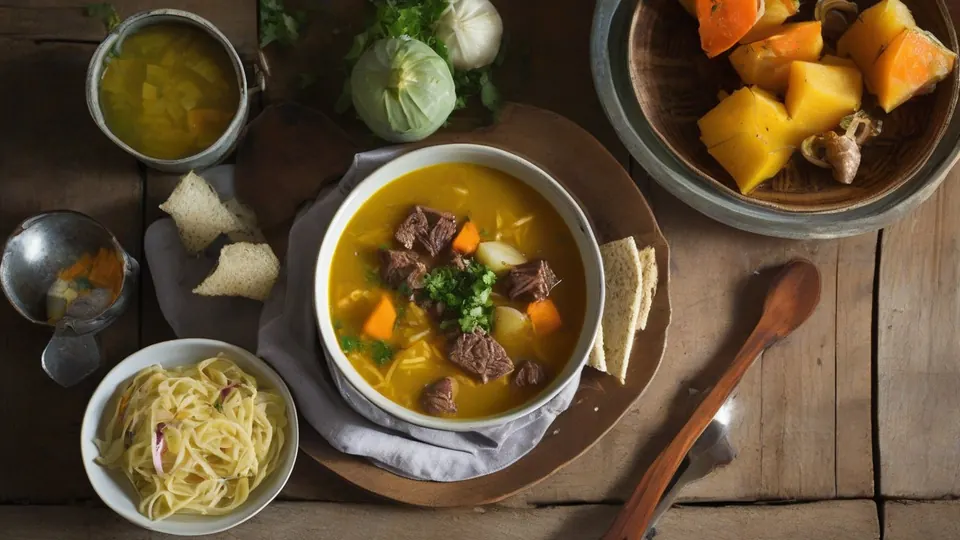
Soup joumou
Squash soup with beef, vegetables and pasta, eaten on 1 January, Haiti's Independence Day. UNESCO added it to the list of the intangible cultural heritage of humanity in 2021.
Griot
Pork shoulder marinated in sour orange and spice, simmered, then fried until the edges turn crisp.
Pikliz
Shredded cabbage, carrot and hot pepper pickled in vinegar. It sits beside griot and fried plantain on almost every plate.
Diri ak pwa
Rice cooked together with beans, red or black: the base of the everyday meal.
Akra
Fritters of grated malanga root, fried in small pieces and eaten as a snack.
The year.
Two fixed days open the Haitian year, the carnival follows Easter's calendar, and the flag has its own day in May.
Fixed and moving dates
| When | What | How the date behaves |
|---|---|---|
| 1 January | Independence Day | Fixed. Haiti declared its independence in 1804; the day is eaten as soup joumou. |
| 2 January | Ancestors' Day | Fixed. Honours the founders of independence. |
| February or March | Kanaval | Moves with Easter: the days before Ash Wednesday. |
| 18 May | Flag Day | Fixed. The bicolour flag dates from 1803. |
| Christmas · Easter | Marked by Catholic and Protestant families | Christmas is fixed; Easter moves every year. |
Where the community gathers.
A parish, a French-language classroom and a home kitchen carry most of the weekly life.
Four kinds of place
Parishes and congregations
Catholic parishes and Protestant congregations carry much of the weekly life: choirs, youth groups, weddings and funerals.
French-language schools
Ontario's French-language school boards, public and Catholic, teach in French from kindergarten on.
Clubs and associations
Clubs and associations run the dinners, the dances and the committees that carry the year from one celebration to the next.
Home kitchens and caterers
A tray of griot from a home kitchen on a Saturday does part of the work of a community centre.
At the festival.
A Haitian pavilion at Capital Cultures could put soup on the stove, kompa on the stage and Creole at the language corner. The community decides all of it.
First edition · September 2027 · free entry
- The kitchen decides the menu. Food, drink and souvenirs sold at a community pavilion stay with the community in full, and the pavilion fee is zero.
- The stage is programmed by the community. We hold the schedule, the sound and the licences; the community holds who performs and in what order.
- A community festival and a pavilion here are separate things. Any Haitian celebration the community already holds in Ottawa stays entirely its own, and a pavilion in September takes nothing from it.
- 01The community sends the pavilion application (ten minutes)
- 02A person answers within ten working days
- 03The board reads the published terms
- 04Both sides sign the participation agreement
- 05The pavilion opens on the field, September 2027
Short answers.
What people ask about Haitian Ottawa, answered from the census and the community calendar.
6 questions
How many Haitians live in Ottawa?
Census 2021 counts 9,780 Ottawa residents of Haitian origin, alone or with other origins, and 6,705 residents born in Haiti, seventh among the birthplaces of the city's immigrants. 985 people arrived from Haiti between 2016 and 2021.
Is the Haitian community in Ottawa French-speaking?
French and Haitian Creole are Haiti's two official languages, so most Haitian families arrive speaking at least one of them. In Ottawa 8,565 residents can speak Haitian Creole and 3,240 have it as their mother tongue (Census 2021). Ontario's French-language school boards teach in French from kindergarten on.
What do Haitians eat on 1 January?
Soup joumou: squash soup with beef, vegetables and pasta. It marks Independence Day, 1 January 1804, and UNESCO inscribed it on the list of the intangible cultural heritage of humanity in 2021.
Which Haitian holidays fall during the year?
Independence Day on 1 January, Ancestors' Day on 2 January, Kanaval in the days before Ash Wednesday, and Flag Day on 18 May. The full table.
Is there a page for other Caribbean communities?
This is the first Caribbean article on Capital Cultures. Jamaican, Trinidadian and every other Caribbean community can start its own page with the editor through the form at the foot of this page.
Can the Haitian community run a pavilion at Capital Cultures?
Yes. Capital Cultures is a free two-day multicultural festival in Ottawa in September 2027. Each pavilion is run by a community: it plans its menu and stage, keeps what its counter takes, and pays no pavilion fee. A person answers every application within ten working days. How a community applies.
Write this page with us.
Corrections, additions, a family's arrival story, the name of the cook or the maker. The byline belongs to whoever does the work.